- English
- Chinese
- French
- German
- Portuguese
- Spanish
- Russian
- Japanese
- Korean
- Arabic
- Irish
- Greek
- Turkish
- Italian
- Danish
- Romanian
- Indonesian
- Czech
- Afrikaans
- Swedish
- Polish
- Catalan
- Esperanto
- Hindi
- Lao
- Albanian
- Amharic
- Armenian
- Azerbaijani
- Belarusian
- Bengali
- Bosnian
- Bulgarian
- Cebuano
- Chichewa
- Corsican
- Croatian
- Dutch
- Estonian
- Filipino
- Finnish
- Frisian
- Galician
- Georgian
- Gujarati
- Haitian
- Hausa
- Hawaiian
- Hebrew
- Hmong
- Hungarian
- Icelandic
- Igbo
- Javanese
- Kannada
- Kazakh
- Khmer
- Kurdish
- Kyrgyz
- Latin
- Latvian
- Lithuanian
- Luxembou..
- Macedonian
- Malagasy
- Malay
- Malayalam
- Maltese
- Maori
- Marathi
- Mongolian
- Burmese
- Nepali
- Norwegian
- Pashto
- Persian
- Punjabi
- Serbian
- Sesotho
- Sinhala
- Slovak
- Slovenian
- Somali
- Samoan
- Scots Gaelic
- Shona
- Sindhi
- Sundanese
- Swahili
- Tajik
- Tamil
- Telugu
- Thai
- Ukrainian
- Urdu
- Uzbek
- Vietnamese
- Welsh
- Xhosa
- Yiddish
- Yoruba
- Zulu
- Kinyarwanda
- Tatar
- Oriya
- Turkmen
- Uyghur

Flat Tempered Glass Lids vs. Domed Lids: How to Choose for Cookware
2026-11-01
Introduction: The Core Choice for Cookware OEM Design
Selecting the right glass lid shape directly decides your cookware’s market competitiveness for OEM and ODM projects.A flat tempered glass lid and dome tempered glass lid are the two mainstream tempered glass cover solutions for cookware lines. Browse our ordinary glass lid collection for standard options. Your lid selection affects cooking performance, stacking efficiency, packaging and ocean freight cost, product visual style, and cross-model compatibility all at once.
This article focuses strictly on head-to-head comparison between flat glass lid and dome glass cover, without repeating standalone introductions of domed lids that already exist on our website. As a quick example: shallow frying pans match flat styles perfectly, while deep stockpots are better paired with domed versions. Many OEM buyers and product designers struggle with mismatched fit, rising logistics costs, or inconsistent brand positioning caused by wrong lid selection. This guide helps you avoid these common pitfalls.
1. Structural & Contour Differences Between Flat and Domed Glass Lids
1.1 Outline & Curvature Design
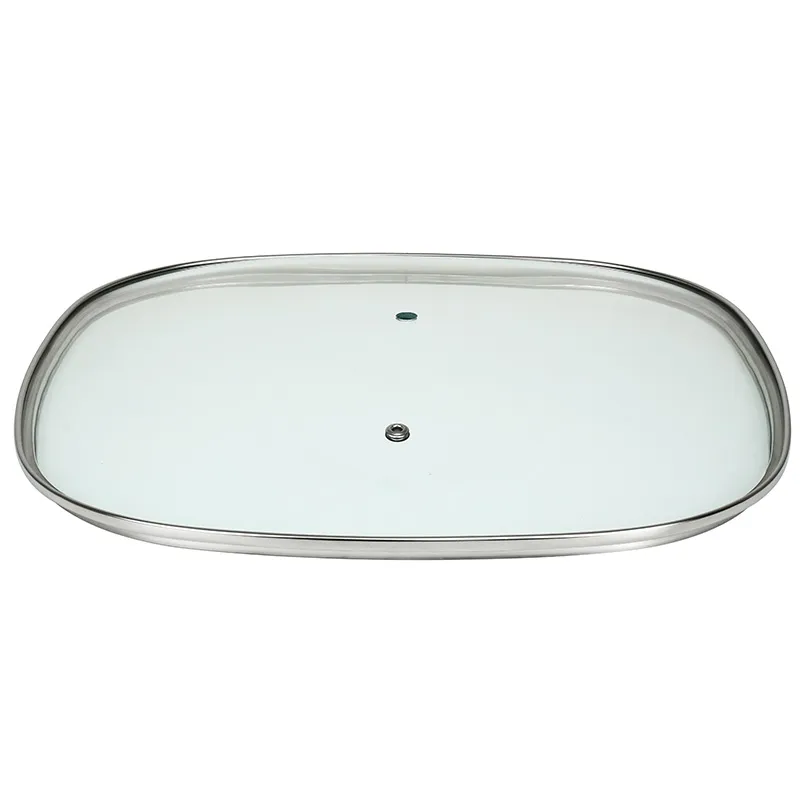
A flat tempered glass lid features a fully level surface with zero curvature. Its total height only equals the glass thickness plus the metal rim, with a vertical rise of 0 mm for standard sizes.
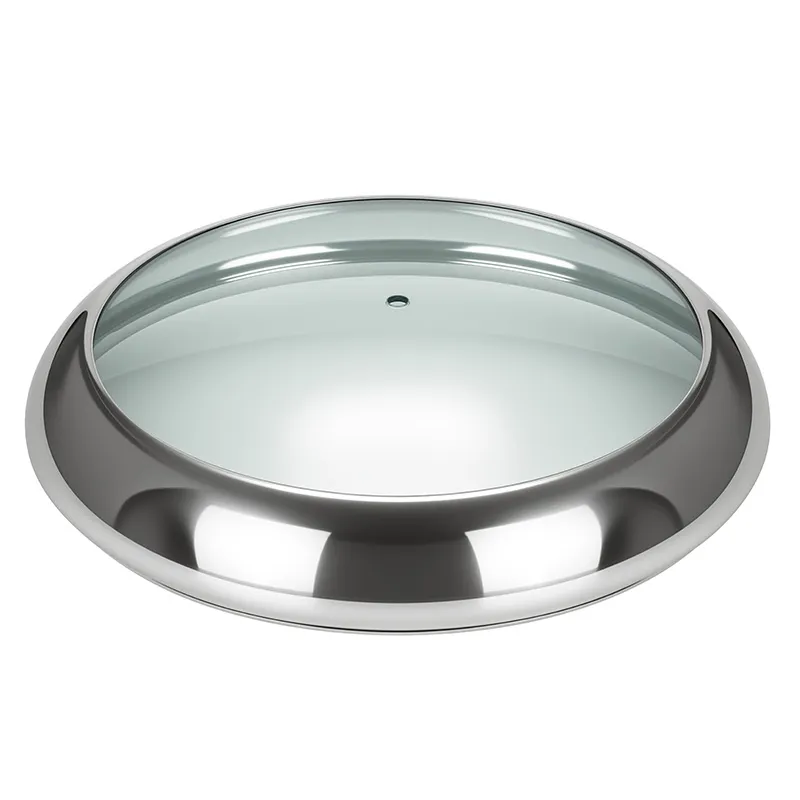
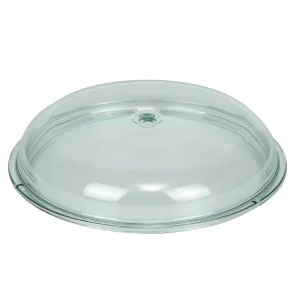
By contrast, a dome tempered glass lid curves upward from the rim to the center. It creates an arched profile with measurable height difference between the edge and the middle. For an 8-inch lid, typical dome height ranges from 15 mm to 40 mm depending on the design.
1.2 Glass Structure & Mechanical Design Notes
Flat glass lids have even surface distribution. Stress spreads evenly across the whole panel during heating and impact. Domed lids concentrate greater thermal stress on the arched central section when temperature changes sharply.
Important statement: It is impossible to conclude which design is inherently stronger without physical testing. The actual structural strength gap must be verified via impact resistance and thermal shock tests, with formal technical test reports provided by the glass lid supplier. No generalized strength judgment can be made based only on shape.
Fact pending verification: Thermal stability data corresponding to different dome heights requires test documents from the supplier.
2. Internal Cooking Space & Height Requirements
2.1 Internal Headroom Comparison
A flat glass lid sits flush with the pot rim, leaving minimal vertical clearance inside the cookware. This design works best for shallow pans, frying pans and sauce pans, as it limits condensation dripping onto finished dishes.
A dome glass cover adds vertical interior space thanks to its arched shape. The extra headroom leaves room for food expansion during cooking, effectively reducing boil-over risks for soups, stews and steaming tasks.
Example: Domed lids fit cooking whole chicken or steamed rice; a flat tempered glass lid is the better option for pan-frying and sauce reduction in shallow cookware.
2.2 Condensation & Steam Circulation Difference
On flat lids, condensed water drops straight down directly onto the food below. On domed lids, water vapor condenses along the curved inner surface and flows back toward the pot rim, creating more balanced steam circulation inside the pot.
Note: The real gap in steam performance cannot be judged only by appearance. Valid comparison results must come from side-by-side steaming experiments under identical temperature and time settings.
Fact pending verification: Condensation reflux performance under different dome heights needs measured test data.
3. Compatibility with Different Cookware Types
3.1 Cookware Matching Rules
Flat tempered glass lids are designed for shallow cookware: frying pans, flat woks, shallow stockpots and flat-bottom sauce pans with low sidewalls and perfectly level top rims.
Dome tempered glass lids match deep cookware, including deep stockpots, casseroles, steam pots and large-capacity household pots that require extra vertical space for bulky food.
3.2 Fit Tolerance & Rim Matching
Flat glass lids demand higher flatness on the pot mouth. Even minor warping on the rim will cause wobbling and poor sealing. Domed glass covers tolerate slight rim deformation far better.
Critical reminder: You cannot freely swap these two lid types on the same pot. Cross-use will lead to loose fitting, shaking and steam leakage. The lid contour must strictly align with the pot rim drawing.
Example: A 24 cm shallow fry pan can only use a flat lid, while a 24 cm deep stockpot needs a domed lid.
Fact pending verification: The corresponding relationship between pot rim flatness and sealing performance for both lid styles requires supplier blueprints and sealing test records.
4. Storage, Stacking, Packaging & Shipping Cost Differences
4.1 Stacking & Cabinet Storage Efficiency
Flat glass lid can be stacked layer upon layer without gaps, since there is no protruding arch. This greatly reduces vertical storage space and improves warehouse stacking density.
Dome glass cover cannot be tightly stacked due to its raised center. It can only be placed one layer high, occupying much more warehouse volume and raising the risk of chipping and breakage during handling.
4.2 Packaging Quantity & Freight Cost
Flat lids allow more pieces per carton, lower cardboard packaging cost per unit, higher full-container loading rate, and lower per-piece ocean shipping expense.
Domed lids need extra corner protectors and inner foam inserts to prevent breakage. Fewer units fit into one carton, which lowers container utilization and pushes up single-piece logistics cost.
Note: Breakage rate differences cannot be assumed by shape alone. Valid conclusions must rely on drop tests with the finalized packaging plan.
Example: For identical lid sizes, one carton can hold 60 flat tempered glass lids, while only 30 to 40 domed lids fit into the same carton. This directly cuts container loading capacity by nearly half.
Fact pending verification: Standard carton quantities, individual package volume and full container loading data for both lid types need factory packing records.
5. Visual Appearance & Brand Series Positioning
Flat tempered glass lid delivers a minimalist, clean and modern aesthetic. It fits perfectly with European and American contemporary kitchen trends, luxury minimalist cookware lines and high-end premium product sets with a sleek, tidy profile.
Dome glass cover is a classic traditional design. It suits mainstream household cookware and mass-market supermarket product lines with a fuller, more conventional look.
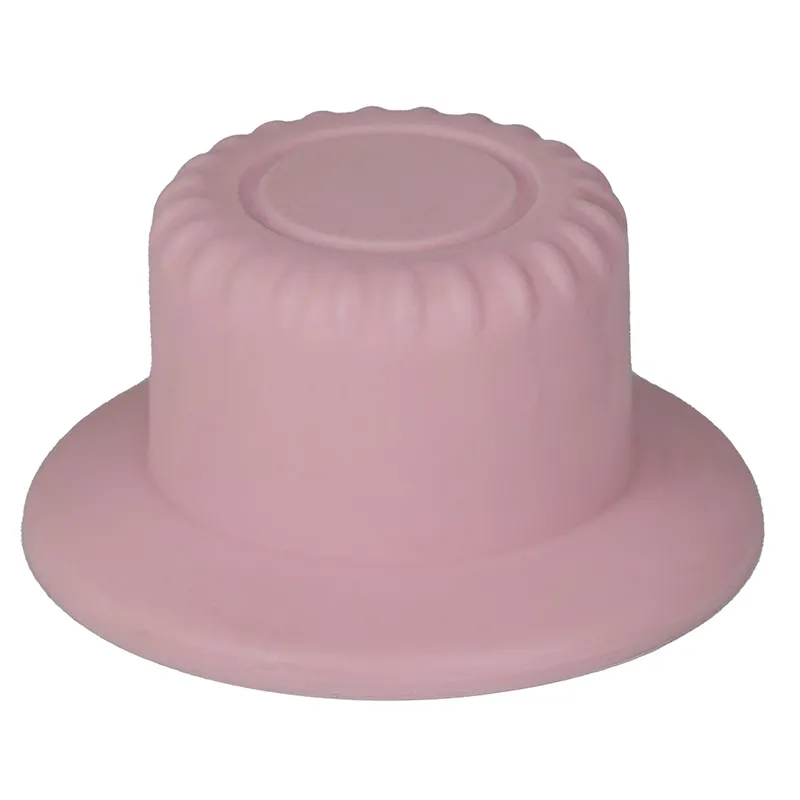
OEM brands can build tiered product portfolios using both styles: apply flat glass lid on high-end minimalist lines, and use dome glass cover on affordable mass-market cookware to differentiate product positioning without extra development costs. We also provide colorful silicone glass lid designs for premium cookware sets.
Example: Non-stick pan premium sets adopt flat lids; family-sized soup pot packages use domed lids.
6. OEM Buyer Selection Guide: Choose Based on End Use
6.1 Scenario-Based Selection Criteria
Prioritize flat tempered glass lid if your project meets these conditions:
- Product line: shallow pans and frying pans
- Brand positioning: minimalist high-end kitchenware targeting Western markets
- Business constraints: tight warehouse storage limits, need to cut ocean freight cost
- Primary cooking: sauce simmering and shallow pan stir-frying
Prioritize dome tempered glass lid for these scenarios:
- Product line: deep stockpots, stew pots and steam cookware
- Brand positioning: conventional mass-market home cookware
- Primary cooking: boiling, stewing, braising and steaming
- Core requirement: extra internal space to prevent liquid overflow
Example: European minimalist cookware export orders mostly select flat lids; Southeast Asian family soup pot orders typically choose domed covers.
6.2 Avoid Wrong Selection Pitfalls
- Do not arbitrarily interchange flat and domed lids just to simplify inventory management.
- Do not focus only on unit glass price while ignoring long-term stacking and freight expenses.
- Never judge glass durability purely by visual shape; always require pre-production sample testing.
7. Supplier Communication, Drawing Confirmation & Sample Validation
7.1 Technical Drawing Confirmation Points
For flat tempered glass lid: Lock down overall flatness, glass thickness, outer rim diameter, steam hole position, and strict zero arch height requirements in written technical drawings.
For dome tempered glass lid: Clearly define dome height, curve radius, central rise and rim fitting tolerance.
All dimensional tolerances must be fixed on paper to avoid inconsistent arch height or warped flat lids during mass production.
7.2 Pre-Production Sample Testing Items
Before mass order release, run these verification tests on sealed samples:
- Rim fitting test: Test the lid on the matched pot to check sealing tightness and wobble.
- Tempered safety test: Verify fragment state and thermal shock resistance with third-party inspection reports.
- Stacking drop test: Assess breakage risk under the confirmed packaging scheme.
Repeated reminder: Never agree on durability verbally. All performance standards must be backed by sample testing and official inspection documents.
Example: Flat lids require strict flatness inspection; domed lids must be checked for consistent dome height within tolerance limits.
Fact pending verification: Industry tolerance standards for flatness of flat glass lids and dome height deviation need to be confirmed against national or industry specification documents.
8. Key Specifications & Quality Requirements Before Mass Purchase
Before bulk production, lock these core parameters and quality clauses to stabilize mass production quality:
Basic universal specs: glass thickness, tempering grade, stainless steel rim grade, outer diameter tolerance, steam vent location.
Special control points by lid type:
- Flat tempered glass lid: Focus on surface flatness, zero warping, and strict control over edge chipping.
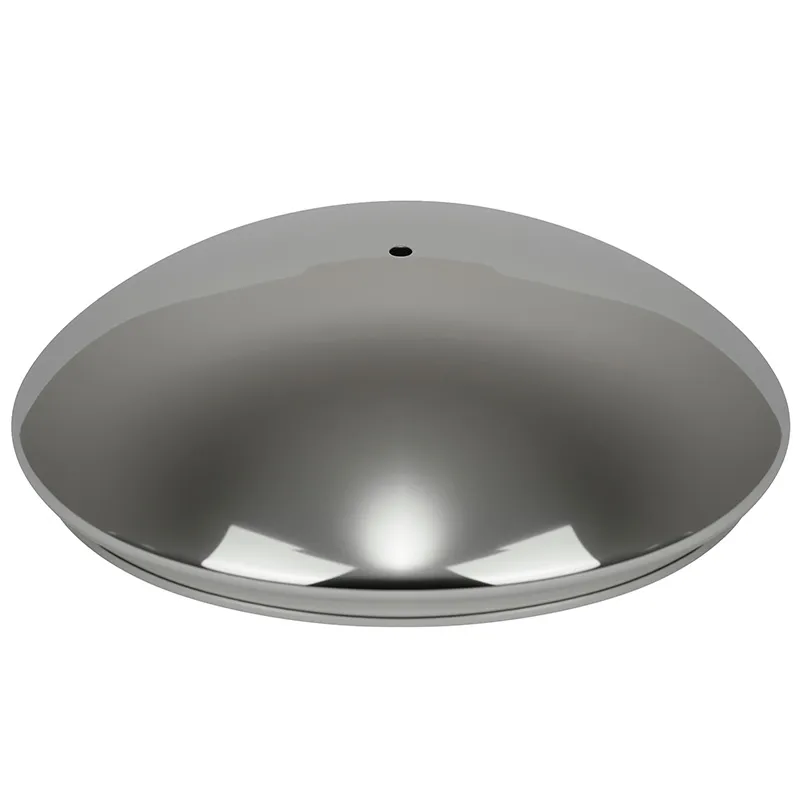
- Dome glass cover: Focus on consistent dome height, uniform curved surface, and elimination of localized stress concentration.Our G-type domed glass lid follows strict tolerance standards for arch height.
Mandatory quality certifications: Food contact safety compliance (LFGB / FDA standards) and tempered glass breakage safety standards.
Purchase contract terms: Mass-produced goods must strictly match the sealed pre-production sample, with all dimensional deviation limits written formally into the sales contract.
Reference specification example: Flat lid flatness deviation shall not exceed 0.4% of the nominal diameter; dome height tolerance shall be controlled within ±1 mm.
Fact pending verification: Exact industry technical indicators for flatness and dome height tolerance need cross-checking against official industry standards.
FAQ: Frequently Asked Questions for OEM Glass Lid Buyers
Can a flat tempered glass lid replace a domed lid on deep stockpots?
Generally, this is not recommended. Flat lids provide limited internal headroom, which may lead to frequent boil-over and poor steam retention. Cross-matching can also create poor rim sealing. Note: Actual sealing performance must be validated via sample fitting tests.
Which one has lower overall cost: flat lid or domed lid (including packaging & freight)?
Flat glass lid generally delivers lower total landed cost thanks to higher carton quantities and better container utilization. However, exact cost gaps need factory packing data and ocean freight quotes to confirm.
Is a dome glass cover always more resistant to boiling over?
Domed lids offer larger internal space to hold rising food, which reduces overflow risk in theory. But final performance depends on dome height and steam vent design; real results require actual cooking trials.
Does a flat glass lid have higher risk of cracking under thermal shock?
There is no universal conclusion. Flat lids distribute stress evenly, while domed lids concentrate stress on the arch. The cracking risk difference must be proven by identical thermal shock lab tests on both styles.
Can I stack flat lids without protective packaging?
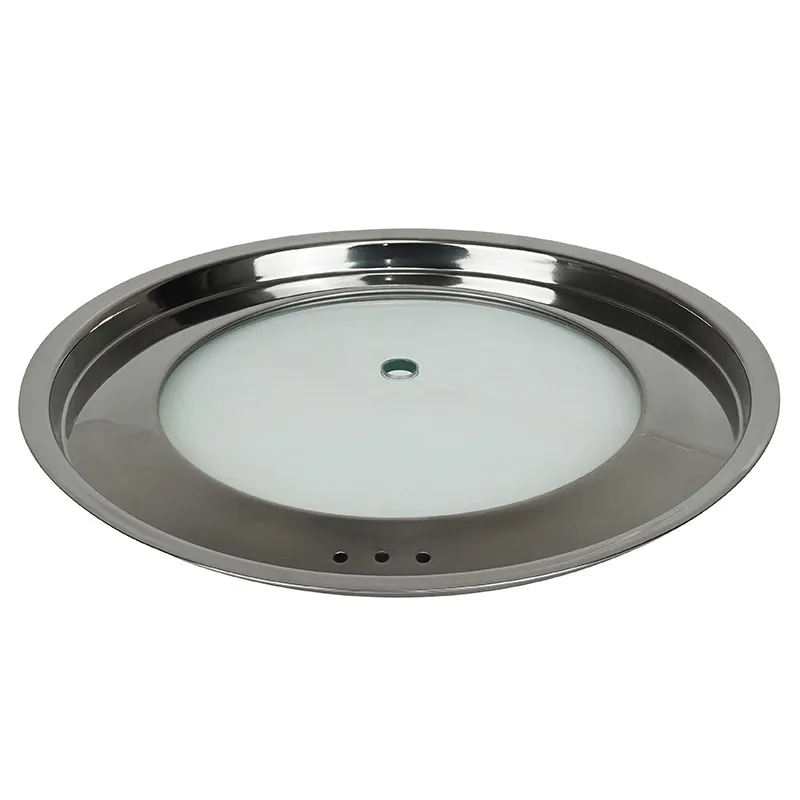
Flat lids can be stacked tightly, but edge chipping risk still exists without separating paper or foam. The safe stacking quantity must be verified through drop and vibration packaging tests. Explore more stainless steel lid styles for heavy-duty cookware projects.
Conclusion: Make the Right Glass Lid Selection for Your Cookware Line
Your final choice between flat tempered glass lid and domed lid depends on four core factors: pot depth, cooking application, warehousing & shipping cost, and brand visual positioning.
Flat tempered glass lids are the cost-effective space-saving option with a minimalist appearance, ideal for shallow pans and high-end premium cookware lines. Dome glass covers provide extra cooking headroom and anti-overflow performance, making them the best choice for deep soup pots and mass-market household product ranges.
Follow this standardized workflow to avoid costly OEM mistakes: lock technical drawings → confirm sealed samples → launch small-batch trial orders → then proceed to full mass production. Reach out to your glass lid supplier to obtain all required test data and technical reports if you have unresolved technical questions. Contact our team to request samples and technical drawings for your OEM cookware project.