- English
- Chinese
- French
- German
- Portuguese
- Spanish
- Russian
- Japanese
- Korean
- Arabic
- Irish
- Greek
- Turkish
- Italian
- Danish
- Romanian
- Indonesian
- Czech
- Afrikaans
- Swedish
- Polish
- Catalan
- Esperanto
- Hindi
- Lao
- Albanian
- Amharic
- Armenian
- Azerbaijani
- Belarusian
- Bengali
- Bosnian
- Bulgarian
- Cebuano
- Chichewa
- Corsican
- Croatian
- Dutch
- Estonian
- Filipino
- Finnish
- Frisian
- Galician
- Georgian
- Gujarati
- Haitian
- Hausa
- Hawaiian
- Hebrew
- Hmong
- Hungarian
- Icelandic
- Igbo
- Javanese
- Kannada
- Kazakh
- Khmer
- Kurdish
- Kyrgyz
- Latin
- Latvian
- Lithuanian
- Luxembou..
- Macedonian
- Malagasy
- Malay
- Malayalam
- Maltese
- Maori
- Marathi
- Mongolian
- Burmese
- Nepali
- Norwegian
- Pashto
- Persian
- Punjabi
- Serbian
- Sesotho
- Sinhala
- Slovak
- Slovenian
- Somali
- Samoan
- Scots Gaelic
- Shona
- Sindhi
- Sundanese
- Swahili
- Tajik
- Tamil
- Telugu
- Thai
- Ukrainian
- Urdu
- Uzbek
- Vietnamese
- Welsh
- Xhosa
- Yiddish
- Yoruba
- Zulu
- Kinyarwanda
- Tatar
- Oriya
- Turkmen
- Uyghur


Glass Lid Specification Sheet for OEM Cookware Orders
2026-10-21
Summary: Prepare an OEM glass lid specification sheet covering dimensions, glass requirements, rim and handle design, sample approval, and packaging.
An OEM glass lid specification sheet helps cookware brands and purchasing teams define product requirements before sampling and mass production.
It should identify the key dimensions, glass specifications, rim construction, handle design, vent configuration, tolerances, packaging requirements, and any details that still need technical confirmation.
For buyers working with a glass lid manufacturer, a clear specification sheet makes quotations easier to compare and provides a shared reference for product development, sample approval, and production.
It does not need to contain every finalized engineering detail at the first inquiry stage. Instead, it should distinguish confirmed requirements from open questions so that the buyer and supplier can work toward an agreed design.
Why a Glass Lid Specification Sheet Matters in OEM Cookware Projects
A glass lid specification sheet records the product requirements agreed upon by the buyer and manufacturer.
It also identifies which decisions remain open, helping both parties avoid making assumptions about the intended design.
Two glass lids with the same nominal diameter may differ in glass thickness, rim construction, handle assembly, vent placement, or packaging.
These differences can affect compatibility, production requirements, and the final quotation.
Reducing misunderstandings during quotation
A request that includes only a lid diameter and a reference photo may not provide enough information for a detailed quotation.
The manufacturer may need to clarify the glass dimensions, edge treatment, rim material, handle configuration, steam vent, surface finish, and packaging requirements.
For example, a round glass lid with a stainless steel rim may require different components and assembly arrangements from a design with a silicone rim.
Even when the nominal diameter is the same, the two products should not automatically be treated as equivalent.
Before requesting a quotation, classify the available information into three groups:
- Confirmed requirements: Dimensions, materials, features, and appearance details already approved by the buyer.
- Preferred options: Design choices that the buyer would like to compare but has not finalized.
- Open technical questions: Details that require drawings, manufacturer feedback, or a feasibility assessment.
This approach allows a supplier to identify missing information and explain which quotation details can be confirmed and which remain provisional.
Keeping samples and mass production consistent
A sample should be evaluated against a defined specification rather than judged by appearance alone.
Before approving a sample, the buyer should confirm the applicable drawing revision, dimensions, materials, components, and appearance requirements.
Any subsequent changes should be documented so that the approved sample and production specification remain aligned.
For example, changing the handle design or rim construction after sample approval may affect component compatibility, assembly, tooling, cost, or production planning.
The manufacturer should assess the proposed change before it is incorporated into the production requirements.
A practical approval record should identify the approved sample, drawing revision, approval date, accepted deviations, and any outstanding conditions.
Identifying the information required for each stage
Not every technical detail needs to be finalized before the first inquiry.
The important point is to identify what is known, what is preferred, and what needs confirmation.
| Specification item | Information to record |
|---|---|
| Product dimensions | Nominal size, measurement reference, and available fit information |
| Glass | Required material, thickness, and applicable specifications |
| Rim construction | Stainless steel, silicone, or another proposed design |
| Handle or knob | Preferred design, material, position, and attachment requirements |
| Steam vent | Whether it is required and any known location requirements |
| Appearance | Color, finish, printing, and visual acceptance criteria |
| Tolerances | Critical dimensions and agreed acceptable limits |
| Packaging | Individual protection, carton configuration, and labeling |
| Order details | Quantity, customization, inspection, and delivery requirements |
The level of detail should reflect the project.
A standard replacement lid may require different documentation from a fully customized OEM product.
Which Dimensions Should Buyers Specify?
Dimensions are among the most important fields in a glass lid specification sheet.
A nominal diameter alone may not fully define the product geometry or establish whether the lid will fit the intended cookware.
Buyers should identify the measurement reference, the relevant profile, and the dimensions that affect compatibility before approving the production drawing.
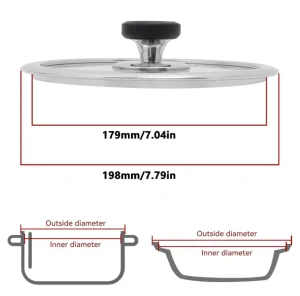
Lid diameter and cookware rim measurement
For a round lid, the nominal diameter is usually the starting point.
However, the buyer and manufacturer should agree on exactly where that diameter is measured.
Depending on the design, the relevant measurements may include:
- The diameter of the glass itself.
- The outside diameter of the assembled lid.
- The outer dimensions of the rim.
- The seating or contact dimensions that determine fit.
- The overall height or profile of the lid, where applicable.
These measurements are not necessarily identical.
A quoted size should therefore identify its measurement reference rather than rely on a number alone.
For replacement lids or products designed for a specific pan or pot, provide the cookware model, relevant rim measurements, or an existing sample if available.
Photographs can help explain the intended design, but they should not replace dimensioned drawings when precise compatibility is required.
Before approving the quotation or sample, confirm the measurement points, the component to which each dimension applies, and the drawing revision that defines the approved geometry.
Flat, domed, round, and special-shaped designs
Glass lids can have different profiles depending on the cookware design and intended application.
A flat lid, a domed lid, and a lid with a specialized perimeter may have different height, clearance, and assembly requirements.
For a domed design, the specification may need to include the overall height and profile geometry.
For a flat design, the buyer should clarify the intended profile and its relationship to the rim.
Square, rectangular, and other non-round designs may require additional details about corner geometry, edge finishing, and the way the lid meets the cookware.
A useful drawing should show the overall shape, key dimensions, relevant cross-sections, and the areas that contact or overlap with the cookware.
This helps the manufacturer assess the design more accurately than a top-view photograph alone.
Dimensional tolerances and drawing approval
A nominal measurement does not define the full acceptable manufacturing range.
Dimensional tolerances establish the permitted variation for a specified measurement.
Buyers should identify critical dimensions and discuss appropriate tolerances with the manufacturer.
Depending on the design, these may include the overall diameter, rim dimensions, glass thickness, profile height, and other measurements that affect assembly or fit.
There is no single tolerance that should automatically be applied to every glass lid.
Suitable limits depend on the geometry, manufacturing process, components, intended fit, and agreed inspection method.
Before mass production, the approved drawing should identify the applicable dimensions and tolerances.
If a measurement is critical to compatibility with a specific pan or pot, communicate that requirement explicitly rather than leaving it open to interpretation.
How to Specify Glass Material and Thickness
Glass specifications affect product design, manufacturing requirements, and inspection.
Buyers should identify the required material and target thickness while allowing the manufacturer to confirm feasibility and applicable production limits.
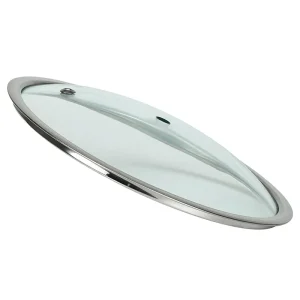
Glass type and tempering requirements
The specification sheet should state whether tempered glass is required and identify any applicable material or performance requirements agreed for the project.
The term “tempered glass” alone does not define every aspect of the finished product.
Depending on the target market and purchasing requirements, the buyer may also need to specify applicable standards, inspection requirements, traceability expectations, or requested documentation.
If a particular standard or certification is required, confirm its exact designation, applicability, and evidence requirements with the manufacturer.
Do not assume that a supplier meets a requirement simply because it manufactures tempered glass lids.
Requirements that have not yet been confirmed should be marked for technical review rather than presented as finalized specifications.
Glass thickness and acceptable variation
Glass thickness should be recorded as a defined dimension rather than inferred from appearance.
For example, if a project requires a nominal thickness of 4 mm, the specification should identify that target and establish the applicable tolerance through the approved technical documentation.
The manufacturer should confirm whether the requested thickness is suitable and available for the proposed design.
A thicker glass panel is not automatically the best choice for every lid.
The finished design also depends on the profile, edge treatment, rim construction, handle attachment, and applicable performance requirements.
Buyers should therefore select thickness based on the intended application and the manufacturer’s confirmed technical capabilities, not solely on a competitor’s photograph or a general product description.
Edge finishing and visible defects
Glass edge quality should be addressed explicitly, especially where the edge remains visible or is covered by a rim.
The specification or quality documentation should identify the required edge treatment and relevant restrictions on visible defects.
The buyer and manufacturer should agree on inspection methods and acceptance criteria rather than relying on subjective descriptions such as “perfect appearance.”
For customized projects, also clarify expectations for surface cleanliness, visible marks, printing, and other appearance-related features.
A rim may cover part of the glass edge, but the covered area still needs to meet the agreed manufacturing and assembly requirements.
How to Define the Rim, Handle, and Vent Design
The rim, handle, and steam vent can affect the appearance, assembly, usability, and compatibility of a glass lid.
Each feature should be specified clearly, and the complete design should be reviewed as one assembly.
Stainless steel rim or silicone rim
A stainless steel rim and a silicone rim represent different design approaches.
The appropriate choice depends on the cookware design, appearance requirements, assembly method, and intended use.
| Specification factor | Stainless steel rim | Silicone rim |
|---|---|---|
| Main design consideration | Metal profile, dimensions, finish, and assembly | Silicone profile, dimensions, material requirements, and attachment |
| Appearance | Metal finish and visual consistency | Color, surface finish, and profile consistency |
| Fit requirements | Rim geometry and contact with the cookware | Rim geometry, flexibility, and contact with the cookware |
| Information to confirm | Material grade, if specified; finish; dimensions; joining method | Material specification; color; dimensions; attachment method |
| Project-specific checks | Corrosion-related requirements and assembly quality, where applicable | Temperature suitability, material compliance, and fit, where applicable |
This comparison is a purchasing checklist, not a universal performance ranking.
The properties of the finished product depend on the specific materials, design, manufacturing process, and applicable requirements.
Buyers should confirm which rim constructions are available from the manufacturer and whether the selected design is compatible with the intended cookware.
For additional product information, see the tempered glass lid with silicone rim page.
Handle or knob requirements
A handle or knob should be described in terms of its design, position, material, attachment method, and appearance.
Depending on the project, the buyer may need to specify:
- Handle or knob shape and dimensions.
- Material and surface finish.
- Color or other visual requirements.
- Mounting position and attachment method.
- Relevant strength, heat-resistance, or usability requirements.
- Any restrictions related to the cookware design or intended use.
Clarify whether the handle is part of the complete lid assembly or supplied as a separate component.
Attachment details matter because the selected glass, handle, and fixing method must be compatible.
The manufacturer should confirm the proposed construction and identify any design limitations before sample approval.
If particular performance tests or compliance documents are required, state those requirements explicitly.
They should not be assumed from the handle’s appearance or material alone.
Steam vent position and design
A steam vent should be treated as a defined design feature rather than an unspecified opening.
The specification should indicate whether a vent is required, its intended position, and any relevant dimensions or appearance requirements.
A drawing should make the vent location clear in relation to the lid center, handle, rim, and other components.
Buyers should also explain the intended application so that the manufacturer can assess the proposed design.
A vented lid should not automatically be described as leakproof, pressure-resistant, or capable of preventing boil-over.
Such claims depend on the complete design and require suitable evidence.
Before production, confirm the vent configuration, its relationship to the other components, and any applicable inspection or performance requirements.
What Should Be Included in a Sample Approval Checklist?
Sample approval is the stage at which the buyer verifies that the proposed product matches the agreed specification.
A structured checklist helps identify problems before the design is released for mass production.

Confirming the drawing and reference sample
Before evaluating a sample, confirm which drawing and specification it represents.
The documentation should identify the product reference, drawing revision, key dimensions, material requirements, rim design, handle configuration, vent details, and agreed appearance requirements.
If the manufacturer provides a revised drawing during sampling, review the changes rather than relying on an earlier version.
Where physical reference samples are used, identify them and link them to the relevant project documentation.
This reduces the risk of different parties evaluating different product versions.
Checking fit, appearance, and component assembly
Sample inspection should focus on the requirements that matter for the intended application.
For a replacement lid or a lid designed for a specific cookware model, check fit against the agreed cookware dimensions and compatibility criteria.
A sample that looks correct in a photograph may still have a dimensional mismatch.
Depending on the specification, the inspection may cover:
- Overall dimensions and profile.
- Rim fit and consistency.
- Handle position and attachment.
- Steam vent location, where applicable.
- Glass edge finishing and visible appearance.
- Surface finish, color, and printing, if specified.
- Packaging and protection requirements, where relevant.
Acceptance criteria should be defined before inspection.
If a sample does not meet a requirement, record the issue, identify the affected specification, and request a proposed correction.
Recording revisions before mass production
Sample approval should be documented rather than communicated only through informal messages.
A practical approval record can include the approved sample reference, drawing revision, date of approval, accepted deviations, outstanding conditions, and the person or team authorizing release.
If a change is proposed after approval, assess its effect on dimensions, components, tooling, inspection, cost, or lead time before accepting it.
This creates a traceable link between the original requirement, the approved sample, and the production specification.
It also helps prevent unapproved changes from being introduced during subsequent orders.
What Packaging and Order Details Should Be Confirmed?
A complete OEM specification should cover packaging and commercial requirements in addition to the product itself.
These details affect how the finished lids are protected, identified, inspected, and delivered.
Individual protection and carton configuration
Glass lids need packaging appropriate to their geometry, edge protection requirements, and shipping conditions.
The buyer should communicate the intended packaging format and any specific requirements for individual protection, separators, carton configuration, labeling, or outer packaging.
For bulk orders, it may also be necessary to define carton quantities, carton dimensions, stacking requirements, and product identification information.
The manufacturer should confirm which packaging options are available and whether custom packaging requires separate approval.
The final packaging arrangement should be evaluated against the product design and the buyer’s handling and distribution requirements.
Do not assume that a standard packaging method is suitable for every lid shape or order configuration.
Order quantity, labeling, and customization
The specification or accompanying purchase documentation should state the expected order quantity and any customization requirements.
These may include product branding, labels, colors, printing, special packaging, or other project-specific features.
Each requirement should be identified clearly so that the manufacturer can evaluate feasibility and reflect it accurately in the quotation.
If the project includes multiple lid sizes or designs, assign a distinct product reference to each version.
This helps prevent different specifications from being confused during sampling, production, and order fulfillment.
Lead time and inspection arrangements
Confirm the expected production schedule with the manufacturer after the product requirements and order details have been reviewed.
The quotation or order agreement should clarify the applicable lead time, the events that start the production schedule, sample approval requirements, inspection arrangements, and other conditions that affect delivery.
Lead time should not be assumed to be identical across projects.
Custom components, design revisions, packaging requirements, and order quantities may affect the schedule.
If an inspection is required before shipment, agree on the inspection scope, acceptance criteria, timing, and documentation in advance.
A Practical Glass Lid Specification Sheet Template
The following template can be used to prepare an initial request for quotation or organize an OEM cookware project.
It separates information that buyers can often provide at the inquiry stage from details that may require technical confirmation.
Information to provide for an initial quotation
| Field | Information to provide |
|---|---|
| Product reference | Product name, project number, or reference image |
| Intended application | Cookware type or compatible product model |
| Available dimensions | Nominal diameter or overall dimensions, with measurement references if known |
| Reference material | Existing lid, cookware sample, technical drawing, or photographs, if available |
| Proposed design | Flat or domed profile, rim type, handle or knob, and steam vent preference |
| Customization | Logo, color, printing, or other requested features |
| Order quantity | Estimated quantity and number of product variants |
| Target market | Destination market and any known compliance requirements |
| Packaging | Standard or customized packaging preference |
| Open questions | Requirements that need manufacturer confirmation |
A buyer does not need to have every field finalized before making an initial inquiry.
Available information should be clearly identified, and missing details should be marked as pending confirmation.
Technical details to confirm before production
| Field | Information to confirm |
|---|---|
| Final dimensions | Approved measurements, references, and applicable tolerances |
| Glass specification | Material type, nominal thickness, and applicable requirements |
| Edge finishing | Required edge treatment and acceptance criteria |
| Rim construction | Confirmed material, profile, dimensions, and assembly method |
| Handle or knob | Approved design, material, position, and attachment method |
| Steam vent | Confirmed configuration and location, where applicable |
| Appearance | Approved color, finish, printing, and visual criteria |
| Technical drawing | Drawing reference, revision, and approval status |
| Sample approval | Sample identification, inspection results, and approval record |
| Packaging | Confirmed protection, carton configuration, and labeling |
| Inspection | Agreed inspection scope and acceptance criteria |
| Delivery | Confirmed schedule and relevant order conditions |
The buyer should distinguish between requested requirements and the manufacturer’s confirmed capabilities.
This is especially important for custom dimensions, material specifications, tolerances, and performance requirements.
The approved specification should serve as the shared reference for the quotation, sample review, and production release.
Changes should be recorded against the relevant drawing or specification revision.
Conclusion
A clear glass lid specification sheet helps OEM cookware buyers turn a general product idea into a defined manufacturing requirement.
The most important information includes dimensions, glass specifications, rim construction, handle and vent design, tolerances, sample approval criteria, packaging, and order conditions.
The level of detail should match the complexity of the project.
A standard design may require a relatively simple specification, while a customized lid or a replacement product intended for a specific cookware model may need more detailed drawings and compatibility checks.
Buyers can begin an inquiry with the information already available, such as the intended cookware, approximate dimensions, reference photos or samples, proposed design, quantity, and packaging preferences.
The manufacturer can then identify missing technical details and confirm what is needed before sampling and mass production.
For more information about relevant product designs and manufacturing, see the tempered glass lid for cookware and glass lid manufacturing pages.
Providing the available specifications and reference materials gives the supplier a clearer basis for evaluating feasibility and preparing a project-specific quotation.