
- Chinese
- French
- German
- Portuguese
- Spanish
- Russian
- Japanese
- Korean
- Arabic
- Irish
- Greek
- Turkish
- Italian
- Danish
- Romanian
- Indonesian
- Czech
- Afrikaans
- Swedish
- Polish
- Basque
- Catalan
- Esperanto
- Hindi
- Lao
- Albanian
- Amharic
- Armenian
- Azerbaijani
- Belarusian
- Bengali
- Bosnian
- Bulgarian
- Cebuano
- Chichewa
- Corsican
- Croatian
- Dutch
- Estonian
- Filipino
- Finnish
- Frisian
- Galician
- Georgian
- Gujarati
- Haitian
- Hausa
- Hawaiian
- Hebrew
- Hmong
- Hungarian
- Icelandic
- Igbo
- Javanese
- Kannada
- Kazakh
- Khmer
- Kurdish
- Kyrgyz
- Latin
- Latvian
- Lithuanian
- Luxembou..
- Macedonian
- Malagasy
- Malay
- Malayalam
- Maltese
- Maori
- Marathi
- Mongolian
- Burmese
- Nepali
- Norwegian
- Pashto
- Persian
- Punjabi
- Serbian
- Sesotho
- Sinhala
- Slovak
- Slovenian
- Somali
- Samoan
- Scots Gaelic
- Shona
- Sindhi
- Sundanese
- Swahili
- Tajik
- Tamil
- Telugu
- Thai
- Ukrainian
- Urdu
- Uzbek
- Vietnamese
- Welsh
- Xhosa
- Yiddish
- Yoruba
- Zulu
- Kinyarwanda
- Tatar
- Oriya
- Turkmen
- Uyghur


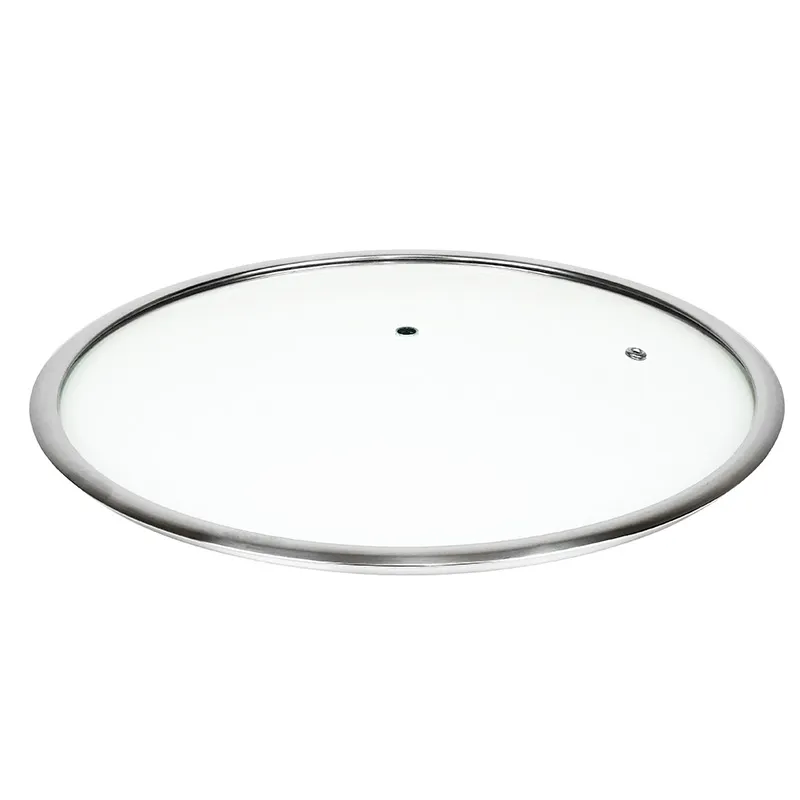
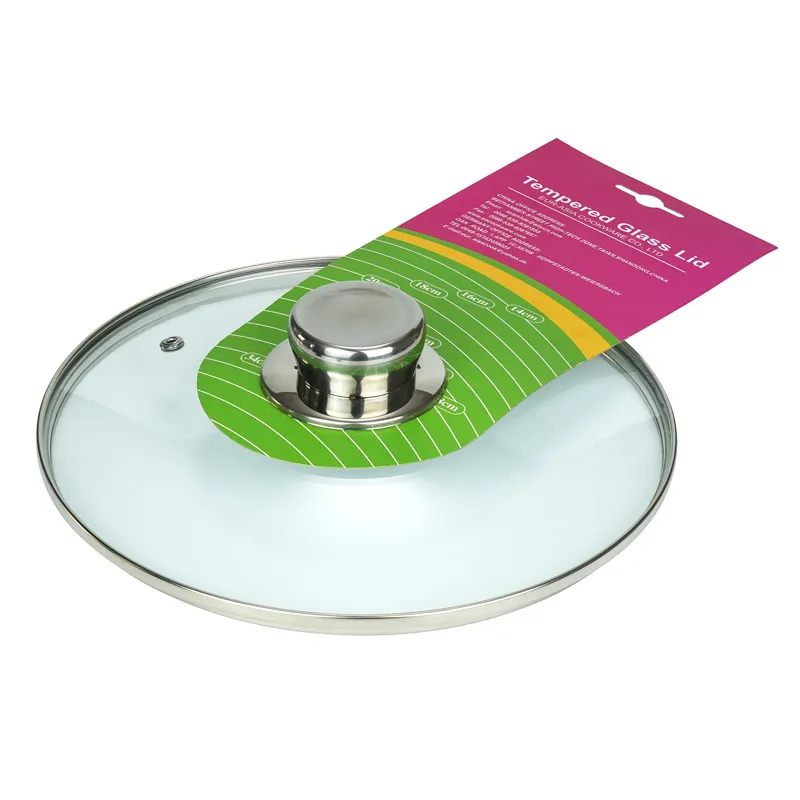
14 inch tempered glass lid
When you hear '14 inch tempered glass lid', the immediate thought for most, even some buyers, jumps to thickness. Is it 3mm or 4mm? 5mm must be better. That's the first misconception. In reality, for a lid of this diameter, the critical factor isn't just the glass thickness—it's the engineering of the rim, the tempering process consistency, and how it manages thermal stress across that large, flat span. A poorly designed thick lid can fail faster than a correctly engineered thinner one. I've seen it happen on production lines, where a batch of 4mm lids had a higher thermal shock failure rate than the 3.8mm version from the same furnace, all because of a slight change in the notch grinding at the handle attachment points.
The 14-Inch Reality Check
Let's talk size. Fourteen inches is a substantial span for a tempered glass panel. In cookware, this typically fits large stock pots, pasta pots, or certain braisers. The challenge here is deflection. When you lift a hot lid by its central knob, the glass wants to bow slightly. If the tempering isn't perfectly even—meaning the surface compression stresses aren't uniform—that deflection can create a weak point. It's not usually an issue at 8 or 10 inches, but past 12 inches, you really start to see which factories have their quenching process dialed in.
I recall a shipment for a European client a few years back. The 14 inch tempered glass lid samples were perfect, but the first production run had a 5% breakage rate upon initial heating in their QC. The culprit? The lids were resting on a slightly uneven cooling rack post-tempering, causing minute stress variations. They weren't breaking in transit; they were failing under their first real thermal load. The fix was absurdly simple—redesigning the rack—but it cost a three-week delay.
This is where a manufacturer's volume experience matters. A place like EUR-ASIA COOKWARE CO.,LTD, which cites an annual output of over 15 million pieces, has likely run into and solved these scaling issues. Their production base in Taian's High-tech Development Zone is set up for that kind of volume. High volume isn't just about quantity; it's about statistical process control. You see enough lids break in testing to understand the failure modes. You can find them at glass-lid.com – their site details their export focus, which aligns with the stringent standards of markets like Germany and Switzerland. That export orientation is a decent proxy for baseline quality; those markets don't tolerate inconsistent tempering.
Beyond the Millimeter Measurement
So back to thickness. A common spec for a 14-inch lid is 3.8mm to 4.2mm after tempering. The key phrase is after tempering. The glass starts as cut green glass of a specific thickness, but the tempering process itself can cause slight surface ablation. If a supplier just quotes 4mm glass, you need to clarify if that's the raw material or the finished product. A difference of 0.2mm might not sound like much, but it affects the weight, the feel, and the thermal mass.
More important is the edge work. The perimeter of a tempered glass lid is its Achilles' heel. It must be smoothly seamed and ground after tempering to remove any micro-cracks that could become fracture origins. A sharp, chipped edge will almost certainly lead to a spontaneous break. I prefer a fully polished, rounded edge over a simply seamed one for this size. It costs more, but it reduces field failures.
Then there's the silicone gasket in the rim. Its primary job is to seal and cushion, but on a lid this wide, it also helps distribute the clamping force evenly. A thin, cheap gasket can lead to point loading on the glass rim when the lid is clamped down on a pot. Over repeated cycles, that stress can cause a radial crack. It's a failure you often misdiagnose as a thermal shock issue until you look at the fracture pattern.
The Handle and Knob Problem
This is a massive point of failure, arguably more than the glass itself. The metal handle or knob is attached through a hole (or holes) in the glass. This hole is a stress concentrator. The industry standard is to use a metal bushing and a silicone or rubber washer to isolate the metal bolt from the glass, allowing for differential expansion.
I've seen failures where the bushing was slightly undersized, or the washer compressed permanently after a few uses, letting the metal collar touch the glass directly. Once that happens, the direct heat transfer from the handle to the glass creates a localized hot spot. Boom—a classic thermal break originating from the mounting hole. The design from EUR-ASIA COOKWARE likely uses a stainless steel bushing and a high-temperature silicone washer for this reason. Their export to countries with harsh winters (like Russia) and hot climates (like Brazil) means their products have to withstand extreme kitchen-to-table temperature differentials.
The knob's height matters too. A very tall knob provides more leverage when lifting, which is good for the user but applies more torque to that single attachment point. A lower, wider knob or a full handle spanning two attachment points is mechanically superior for a 14-inch lid. It's a trade-off between ergonomics and engineering robustness.
Thermal Shock and the Dishwasher Safe Claim
Every lid claims to be thermal shock resistant. But the test parameters vary wildly. A good quality 14 inch tempered glass lid should handle a 300°C to 20°C differential. That means taking it from a hot oven and placing it on a cold granite countertop. The real-world test is often the wet pot roast scenario: a cold lid placed on a boiling pot. The bottom center of the lid heats rapidly while the edges remain cooler.
The tempering process builds surface compression to resist this, but impurities or nickel sulfide inclusions in the glass (a whole other topic) can cause spontaneous later breaks. High-volume producers mitigate this by using soaked glass—holding the cut pieces at temperature before tempering to allow inclusions to expand and cause breakage before the final tempering. It increases yield loss but reduces field failures.
Now, dishwasher safe. Yes, the glass itself can handle the dishwasher's heat and chemicals. The vulnerability is, again, the handle assembly. Harsh detergents and high-pressure sprays can degrade the silicone gasket over time, and water can seep into the assembly, leading to corrosion of the metal bushing or bolt. I always advise hand-washing the lid to preserve the integrity of the seal around the handle. It's the weakest link in the dishwasher cycle.
Packaging and Logistics: The Silent Killer
You can make a perfect lid, and then ruin it in a cardboard box. For a 14-inch lid, standard compartmentalized cardboard isn't enough. The lid must be suspended, not resting on its rim or face. Good packaging uses a formed plastic clip or a high-density foam ring that holds the lid by its interior, away from the edges, and prevents any contact with the outer box during drops.
A company exporting 90% of its products globally, as EUR-ASIA COOKWARE does, has this down to a science. The cost of a breakage in a container bound for Japan from China isn't just the product cost; it's the logistics nightmare. Their packaging likely reflects this. I'd wager they use a multi-point suspension system within the master carton. It's a detail you only learn after paying for a few claims of arrived broken.
In the end, a 14 inch tempered glass lid is a deceptively simple product. The good ones feel solid, sit flat, have a consistent, smooth finish on the edge, and a robust, well-isolated handle. The failures are almost always in the details: a rushed edge grind, a subpar gasket, an uneven tempering quench. When sourcing, you look for a manufacturer that has the scale to have encountered these problems and the process controls to prevent them. It's less about the spec sheet and more about the institutional knowledge baked into their production line. That's what you're really buying.
Related Products
Related Products

Best Selling Products
Best Selling Products
Related Search
Related Search- cookware tempered glass lid
- glass tupperware bamboo lid
- large glass jar with cork lid
- tempered glass lid manufacturer in China
- le creuset with glass lid
- silicone lid manufacturer of China
- tempered glass lid maker of China
- staub 4 quart enameled cast iron cocotte with glass lid
- staub cast iron 4 qt round cocotte with glass lid
- glass jar with a lid


