- Chinese
- French
- German
- Portuguese
- Spanish
- Russian
- Japanese
- Korean
- Arabic
- Irish
- Greek
- Turkish
- Italian
- Danish
- Romanian
- Indonesian
- Czech
- Afrikaans
- Swedish
- Polish
- Basque
- Catalan
- Esperanto
- Hindi
- Lao
- Albanian
- Amharic
- Armenian
- Azerbaijani
- Belarusian
- Bengali
- Bosnian
- Bulgarian
- Cebuano
- Chichewa
- Corsican
- Croatian
- Dutch
- Estonian
- Filipino
- Finnish
- Frisian
- Galician
- Georgian
- Gujarati
- Haitian
- Hausa
- Hawaiian
- Hebrew
- Hmong
- Hungarian
- Icelandic
- Igbo
- Javanese
- Kannada
- Kazakh
- Khmer
- Kurdish
- Kyrgyz
- Latin
- Latvian
- Lithuanian
- Luxembou..
- Macedonian
- Malagasy
- Malay
- Malayalam
- Maltese
- Maori
- Marathi
- Mongolian
- Burmese
- Nepali
- Norwegian
- Pashto
- Persian
- Punjabi
- Serbian
- Sesotho
- Sinhala
- Slovak
- Slovenian
- Somali
- Samoan
- Scots Gaelic
- Shona
- Sindhi
- Sundanese
- Swahili
- Tajik
- Tamil
- Telugu
- Thai
- Ukrainian
- Urdu
- Uzbek
- Vietnamese
- Welsh
- Xhosa
- Yiddish
- Yoruba
- Zulu
- Kinyarwanda
- Tatar
- Oriya
- Turkmen
- Uyghur


crystal glass jar with lid
When most people hear 'crystal glass jar with lid,' they picture a pristine, sparkling container on a fancy shelf. That's the marketing image. The reality in production and daily use is messier, full of compromises and tiny details that separate a good jar from a great one. The term 'crystal' itself is often a misnomer in this category—it's usually just high-clarity soda-lime glass, but the expectation for brilliance and weight is there, so the name sticks. The lid is where 80% of the functional problems arise, a fact you only learn after dealing with returns.
The Weight of Clarity and the Lid Dilemma
True lead crystal is rare for food storage due to regulations and cost. What we typically work with is a highly refined, low-iron glass formula. This is what gives that water-white clarity, minimizing the greenish tint common in standard glass. A company like EUR-ASIA COOKWARE CO.,LTD, with their focus on tempered glass lids, understands this grade differentiation well. Their production scale—15 million pieces annually—means they're catering to markets like Germany and Japan where clarity and safety standards are non-negotiable. But clarity isn't just aesthetic; it's functional. Being able to see the contents level, the color of your dry goods, matters. A murky jar fails its primary job.
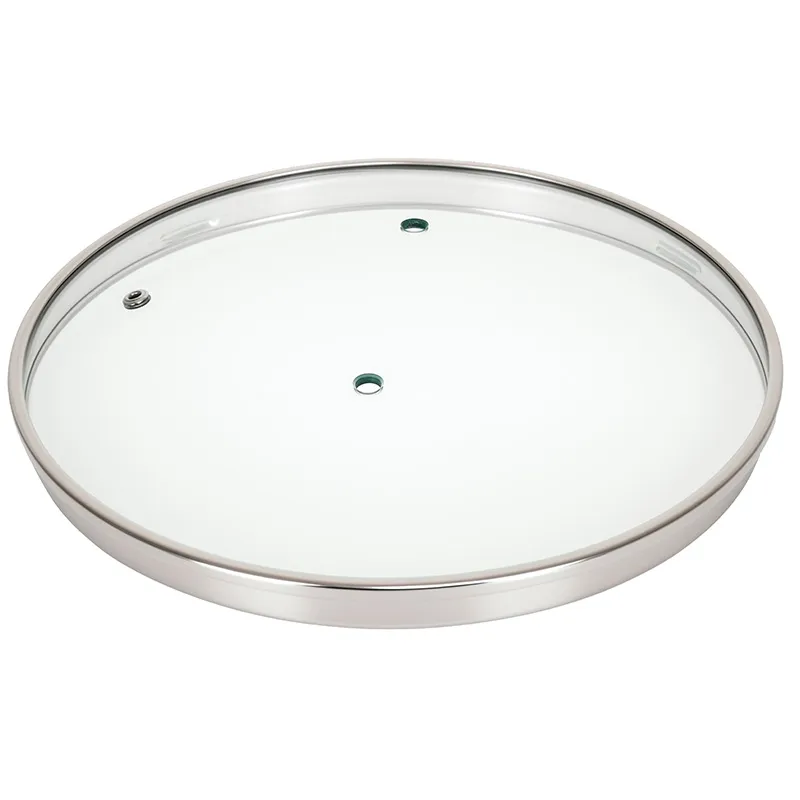
The lid, though. That's the hinge point. The most beautiful jar is ruined by a bad seal or a finicky closure. The industry has moved towards tempered glass lids for oven-safe compatibility and a unified look. But tempering creates a slight dimensional warp—it's a physical process, not a perfect one. This means the sealing surface, often a silicone or BPA-free plastic gasket, has to compensate. I've seen batches where the warp was just a fraction of a millimeter off, and suddenly you have jars that don't seal or are devilishly hard to open. The click isn't crisp. It's a quality control nightmare that isn't apparent until you've filled a hundred units with flour and shaken them.
We tried a run with a metal clasp mechanism on a crystal glass body. Looked gorgeous, very vintage apothecary. Total failure in humid climates. The metal contracted differently, the seal broke, and we got complaints about clumpy sugar. Went back to the drawing board. Sometimes the simplest solutions—a well-designed plastic or bamboo knob on a tempered glass lid with a wide, flat gasket—work best. It's about consistent geometry more than fancy materials.
From Production Line to Kitchen Counter: Real-World Stress Points
Visiting a factory floor changes your perspective. At a facility like the one EUR-ASIA COOKWARE CO.,LTD operates in Taian, you see the stress points. The annealing lehr cooling the glass too fast can introduce internal strain, making the jar more prone to thermal shock breakage. You learn that the junction where the glass jar's neck meets the lid's thread or groove is a critical zone. If the molding isn't smooth, you get micro-cracks over time, especially with repeated washing. This is why a polished, fire-finished rim isn't a luxury; it's a durability feature.
Then there's the lid's underside. Is the gasket glued or mechanically fitted? Glued can fail with heat and dishwasher detergent. Mechanically fitted (snapped into a groove) is superior but costs more. For a high-turnover item like a storage jar, that cost decision is huge. I recall a European client who insisted on a specific food-grade silicone gasket profile. We sourced it, but the retention groove in the glass lid had to be redesigned, adding two weeks to tooling. Was it worth it? For their market, yes. They sold it as a 'premium kitchen system' and the jars held a perfect seal for years.
Stackability is another unsung hero. A good crystal glass jar should stack securely when empty to save cabinet space. This requires a perfectly flat lid top and a jar base that nests into it. It sounds simple, but achieving that without making the lid too thick (and heavy) or the jar walls too thin is a balancing act. Many designs fail here, resulting in wobbly towers that are a accident waiting to happen.
The Export Equation: Meeting Divergent Standards
With over 90% export, as noted in EUR-ASIA's profile, you're not making one product. You're making variants. A jar for the German market might need a specific recyclability logo molded into the glass. For the US, the lid's plastic component might need FDA CFR 21 compliance, while for France, it's something else. The crystal glass jar with lid becomes a document of international standards.
Packaging for export is its own science. These glass items need to survive container shipping—vibration, humidity, temperature swings. The foam inserts must hold each jar and lid separately to prevent 'clinking' that causes chips. We once had a shipment to Brazil where the humidity swelled the cardboard dividers, putting pressure on the jars and causing a 3% breakage rate on arrival. Learned to use wax-coated board for tropical routes. These are the gritty details you don't think about when you buy a jar off a shelf.
The term 'high level' in their company description is key. It's not just about price. It's about the tolerance levels. A 'high level' jar might have a weight tolerance of ±5 grams and a rim concentricity within 0.2mm. A medium-level one might be ±15 grams and 0.5mm. That difference affects the sealing performance directly. When a buyer from Switzerland is paying a premium, they're paying for that tighter tolerance, which ensures every single unit in a batch of 10,000 performs identically.
Failure as a Teacher: The Over-Engineered Lid
In an attempt to create the 'ultimate' seal, we once developed a lid with a dual-gasket system: a primary seal and a secondary vapor barrier. It worked phenomenally well in the lab for herb freshness. But it was a pain to assemble, requiring a precise alignment that slowed down production by 40%. The cost skyrocketed. More fatally, consumers found it confusing to close—'which way does this turn?'—leading to frustration. It was a classic case of solving a problem most users didn't have. The market for dry pasta and coffee beans doesn't need a laboratory-grade seal. They need a reliable, intuitive click.
This experience cemented a rule: user interaction must be idiot-proof. The closure should have a clear tactile or auditory feedback—a snap, a pop, a distinct stop. The best lids I've used have a slight resistance followed by a clean drop into the sealed position. No guessing. This often comes from a well-designed thread or a bayonet-style lug. The glass jar's neck must be shaped to facilitate this, with a lead-in bevel to guide the lid home.
Another lesson was about transparency. We made a lid from a smoked glass to block UV light, thinking it was innovative for tea storage. It tested poorly. People hated not seeing the contents clearly. They preferred a clear glass lid and stored the jar in a cupboard. It taught me to question my own 'improvements' against ingrained user habits.
The Unsung Hero: The Manufacturing Base
The location in Shandong's High-tech Development Zone isn't incidental. It speaks to access to raw materials (silica sand, soda ash), skilled glasswork labor, and logistical links to ports like Qingdao. A 20,000㎡ plant allows for the full vertical process—glass melting, molding, annealing, tempering (for lids), inspection, and packaging—under one roof. This control is vital. It means they can adjust the furnace temperature for a batch of crystal glass to achieve that specific clarity without waiting on a third-party supplier.
Having over 90 employees dedicated to this niche suggests specialization. They're not making drinking glasses and vases on the same line. This focus on tempered glass lid and other glass products for cookware and storage means the engineers and line workers develop a deep, tactile knowledge. They can hear a 'ping' from the tempering quench and know if the stress pattern is right. This isn't automated; it's experienced-based knowledge.
Ultimately, a successful crystal glass jar with lid is a marriage of material science, mechanical design, and humble ergonomics. It's a product that must look beautiful empty on a shelf but perform flawlessly full in a busy kitchen. The companies that get it right, like those supplying the demanding European markets, understand it's not about creating a jewel box. It's about creating a transparent, silent, and utterly reliable workhorse. The sparkle is just a welcome bonus.
Related Products
Related Products