
- Chinese
- French
- German
- Portuguese
- Spanish
- Russian
- Japanese
- Korean
- Arabic
- Irish
- Greek
- Turkish
- Italian
- Danish
- Romanian
- Indonesian
- Czech
- Afrikaans
- Swedish
- Polish
- Basque
- Catalan
- Esperanto
- Hindi
- Lao
- Albanian
- Amharic
- Armenian
- Azerbaijani
- Belarusian
- Bengali
- Bosnian
- Bulgarian
- Cebuano
- Chichewa
- Corsican
- Croatian
- Dutch
- Estonian
- Filipino
- Finnish
- Frisian
- Galician
- Georgian
- Gujarati
- Haitian
- Hausa
- Hawaiian
- Hebrew
- Hmong
- Hungarian
- Icelandic
- Igbo
- Javanese
- Kannada
- Kazakh
- Khmer
- Kurdish
- Kyrgyz
- Latin
- Latvian
- Lithuanian
- Luxembou..
- Macedonian
- Malagasy
- Malay
- Malayalam
- Maltese
- Maori
- Marathi
- Mongolian
- Burmese
- Nepali
- Norwegian
- Pashto
- Persian
- Punjabi
- Serbian
- Sesotho
- Sinhala
- Slovak
- Slovenian
- Somali
- Samoan
- Scots Gaelic
- Shona
- Sindhi
- Sundanese
- Swahili
- Tajik
- Tamil
- Telugu
- Thai
- Ukrainian
- Urdu
- Uzbek
- Vietnamese
- Welsh
- Xhosa
- Yiddish
- Yoruba
- Zulu
- Kinyarwanda
- Tatar
- Oriya
- Turkmen
- Uyghur


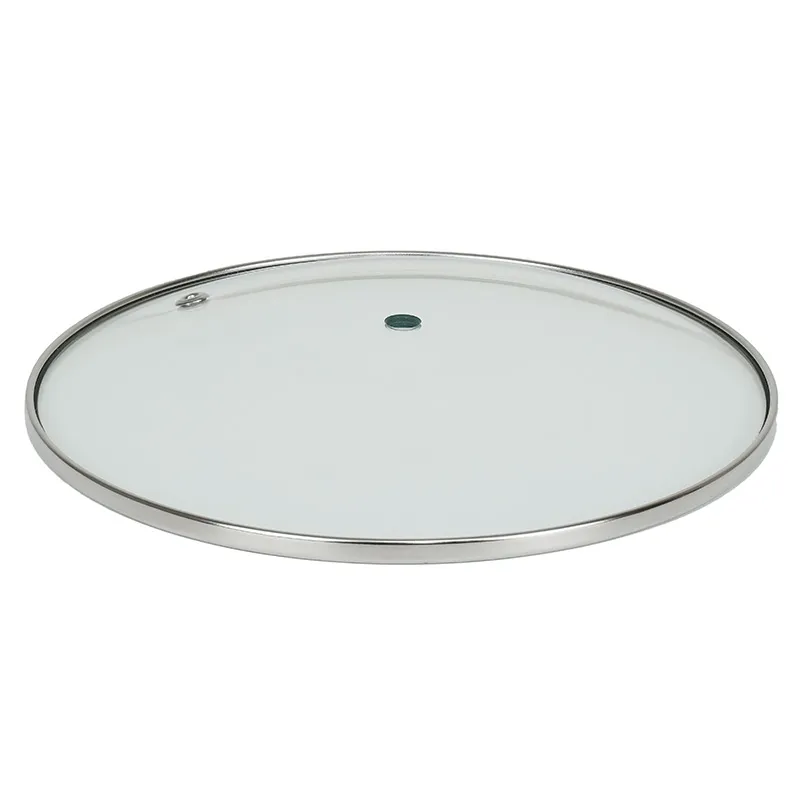
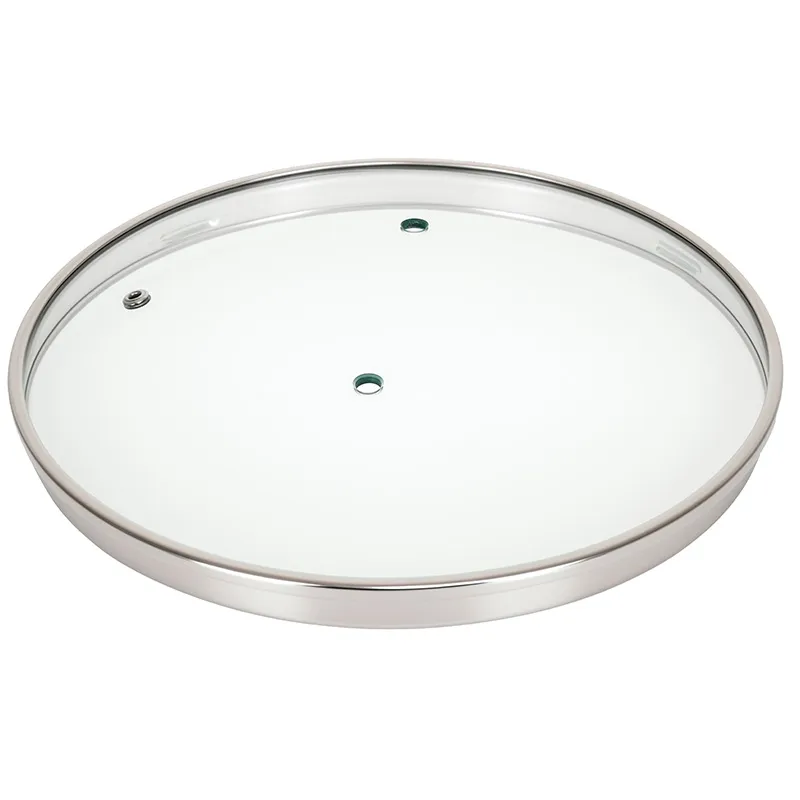
dome tempered glass lid
When you hear 'dome tempered glass lid', most people just think 'see-through pot cover'. That's the surface. The real story is in the curve, the thickness tolerance, and the often-overlooked sealing edge. I've seen too many buyers, even some in the trade, get hung up on price per piece or basic dimensions without grasping how a slight change in the dome's arc radius impacts steam distribution and, frankly, whether the thing will sit flush on a skillet from Italy versus one from South Korea. It's not a commodity item, not if you care about returns and customer complaints.
Defining the Dome – It's Not Just a Shape
The dome isn't there for looks alone. A proper dome, say on a 24cm lid, needs a specific height-to-diameter ratio. Too flat, and you lose the headspace for a rolling boil, causing messy boil-overs. Too high, and it becomes unstable, prone to rocking on the pan. For braising, that dome height is critical—it creates a mini convection oven, redistributing condensation. I recall a batch for a German client where we shaved 2mm off the dome height to fit their new universal cookware line. The lids fit, but their test kitchen reported uneven braising results. We had to go back to the drawing board; the dome was altering the thermal environment inside the pan.
Then there's the transition from the curved dome to the vertical sidewall. This junction is a stress point during tempering. If the mold isn't perfectly designed, you get optical distortion right at that curve, making it hard to see the food underneath clearly. It's a subtle defect, but high-end brands will reject an entire shipment for it. EUR-ASIA COOKWARE CO.,LTD had to invest in a new set of precision molds a few years back specifically to address this for their Japanese market, where visual clarity is non-negotiable.
Material choice for the raw glass is another hidden variable. For a true dome tempered glass lid that can handle thermal shock from an ice-cold fridge to a hot stove, you need low-iron, high-borate glass. It's more expensive, but it tempers more evenly and stays clearer over time. The cheap stuff clouds up after a few dozen dishwasher cycles. You can spot the difference in the greenish edge tint—low-iron glass has a faint blue-grey tint.
The Tempering Process – Where Strength and Flaws Are Born
Tempering is everything. It's what turns a fragile glass disc into something you can (mostly) drop on a tile floor. But the dome shape complicates it immensely. The glass must heat evenly in the furnace, but the thicker rim and the thinner center of the dome heat at different rates. If your furnace zones aren't calibrated perfectly, you get uneven stress patterns. This doesn't always cause immediate breakage; sometimes it manifests as spontaneous shattering months later when someone places it on a slightly warped pan.
We learned this the hard way on an early high-volume order. The lids passed the standard impact test (a steel ball drop), but field reports from Scandinavia started trickling in—lids were popping for no apparent reason. The culprit? An airflow issue in the quenching (rapid cooling) stage. The air nozzles weren't angled correctly for our specific dome curvature, leaving micro-stress fractures in the transition zone I mentioned earlier. Fixing it meant a complete requalification of the tempering line protocol.
The handle attachment point is another critical post-tempering step. You can't drill or glue after tempering—the glass will explode. So, the stainless steel or phenolic knob must be bonded with a special high-temp silicone during the cooling phase. The bond line thickness, the cure time... it's a science. A weak bond, and the handle spins or, worse, detaches when the lid is hot. I've seen suppliers try to cut costs here with inferior adhesive, and it always ends in recalls.
Fit, Finish, and the Reality of Global Standards
Here's a practical headache: there is no universal pan rim standard. A 24cm lid in France might have a 242mm outer diameter with a 235mm sealing surface. The same nominal size in Poland could be 240mm with a 238mm seal. A dome tempered glass lid that's off by even 1mm can wobble or leak steam. EUR-ASIA COOKWARE CO.,LTD maintains a library of hundreds of rim profiles from clients like those in Germany, Italy, and Brazil. Production runs are often segregated by destination country for this exact reason. It's not just about the lid; it's about the specific geometry of the pot it's marrying.
The edge finish is another telltale sign of quality. After tempering, the edge is seared smooth in a process that melts the very surface. A rushed job leaves a sharp, gritty feel. A proper job gives you a satin-smooth, rounded edge that's safe to handle. This is one area where manual inspection is still superior to machines—an experienced worker can run a finger around the rim and feel imperfections a camera might miss.
Then there's packaging. You'd think it's simple, but a poorly designed cardboard sleeve or foam insert can lead to chipping during ocean freight. We once lost 3% of a container to edge chips because the new cost-effective foam was slightly less resilient. That 3% wiped out the profit margin for that entire order. Now, drop-testing the packaged product is part of our standard pre-shipment QC.
Case in Point: The EUR-ASIA Evolution
Looking at a supplier like EUR-ASIA COOKWARE CO.,LTD gives you a snapshot of the industry's trajectory. Starting from a broad base of household glass products, their specialization into producing over 15 million pieces of tempered glass lid annually speaks to the volume and specificity this niche demands. Their location in Shandong's high-tech zone isn't accidental—it gives them access to the material science and engineering talent needed to refine these processes.
Their export footprint—over 90% to markets like Germany, Russia, Japan—is a testament to meeting diverse, stringent standards. The German market demands flawless optics and precise fit. The Japanese market wants minimalist, ultra-clear knobs. The Brazilian market might prioritize cost-effectiveness but still requires solid thermal shock resistance. Serving them all from a single 20,000㎡ facility means having incredibly flexible yet rigorous production lines. It's not a generic factory; it's a hub for solving the specific physical puzzles of glass-on-metal in a kitchen environment.
You can see this specialization on their portal, https://www.glass-lid.com. The focus is clear. It's not a general kitchenware site; it's a destination for a specific component. That tells you they understand their role in the supply chain—they are an engineering and manufacturing partner for cookware brands, not just a vendor.
Lessons from the Field and Forward Look
The biggest lesson? Never assume a lid is just a lid. The failure points are rarely in the obvious places. They're in the differential cooling during tempering, in the 0.5mm tolerance stack-up with a pan, in the long-term durability of the handle adhesive under repeated dishwasher stress. Success is about obsessive control over these micro-details.
Where is it going? I see a push towards even more specialized coatings. Not just silicone gaskets, but hydrophobic coatings on the interior dome to make condensation bead and roll off more efficiently, improving visibility. Also, integration with sensors for smart cooking—embedding a temperature probe port into the glass knob is a technical challenge we're already working on with a European partner.
So, next time you evaluate a dome tempered glass lid, look past the clarity. Press on the dome—does it flex? (It shouldn't). Run your finger around the edge. Check the handle for any minute play. Look at the color of the glass edge. That's where the real quality, or lack thereof, shouts at you. It's a deceptively simple product that embodies a huge amount of materials science and practical engineering. And getting it right is what separates a kitchen essential from a returned item gathering dust in a warehouse.
Related Products
Related Products

Best Selling Products
Best Selling Products
Related Search
Related Search- glass jar with bamboo lid and straw
- round glass jar with cork lid
- glass jar with ceramic lid
- 13pc hexclad hybrid cookware set w lids costco
- glass jar with sealed lid
- guardian cookware glass lids
- libbey glass with bamboo lid
- 13pc hexclad hybrid cookware set w lids
- silicone glass lid made in China
- flat silicone glass cover


