- English
- Chinese
- French
- German
- Portuguese
- Spanish
- Russian
- Japanese
- Korean
- Arabic
- Irish
- Greek
- Turkish
- Italian
- Danish
- Romanian
- Indonesian
- Czech
- Afrikaans
- Swedish
- Polish
- Catalan
- Esperanto
- Hindi
- Lao
- Albanian
- Amharic
- Armenian
- Azerbaijani
- Belarusian
- Bengali
- Bosnian
- Bulgarian
- Cebuano
- Chichewa
- Corsican
- Croatian
- Dutch
- Estonian
- Filipino
- Finnish
- Frisian
- Galician
- Georgian
- Gujarati
- Haitian
- Hausa
- Hawaiian
- Hebrew
- Hmong
- Hungarian
- Icelandic
- Igbo
- Javanese
- Kannada
- Kazakh
- Khmer
- Kurdish
- Kyrgyz
- Latin
- Latvian
- Lithuanian
- Luxembou..
- Macedonian
- Malagasy
- Malay
- Malayalam
- Maltese
- Maori
- Marathi
- Mongolian
- Burmese
- Nepali
- Norwegian
- Pashto
- Persian
- Punjabi
- Serbian
- Sesotho
- Sinhala
- Slovak
- Slovenian
- Somali
- Samoan
- Scots Gaelic
- Shona
- Sindhi
- Sundanese
- Swahili
- Tajik
- Tamil
- Telugu
- Thai
- Ukrainian
- Urdu
- Uzbek
- Vietnamese
- Welsh
- Xhosa
- Yiddish
- Yoruba
- Zulu
- Kinyarwanda
- Tatar
- Oriya
- Turkmen
- Uyghur

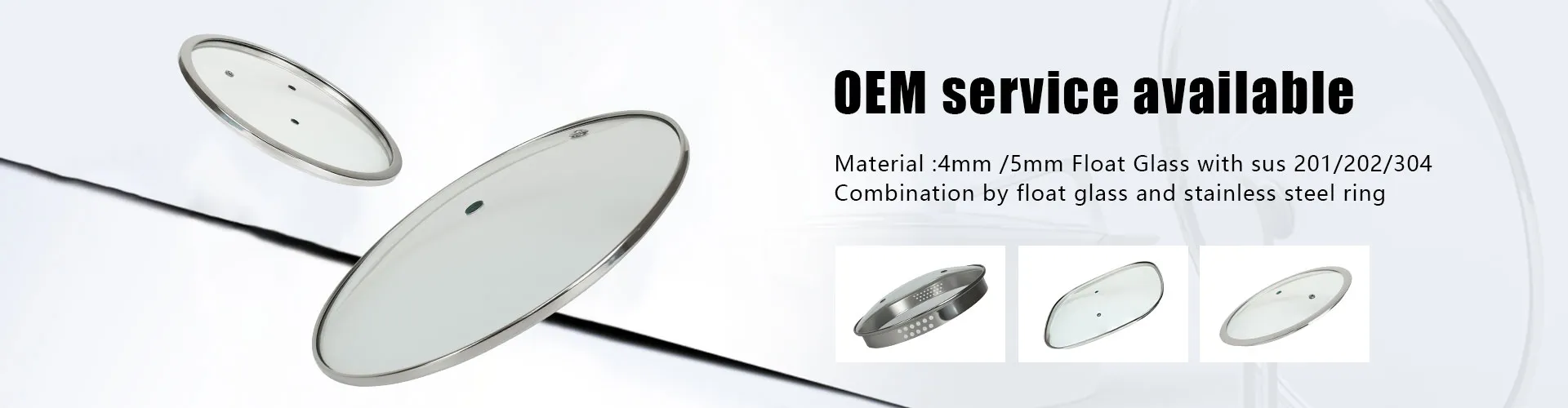
Tempered Glass Lid with Stainless Steel Ring: Rim Structure and Selection
2026-11-12
Sample lids from two suppliers can share the same pot diameter, the same drawing reference and the same description — a tempered glass lid with stainless steel ring — and still behave nothing alike. One seats cleanly, survives a year of daily washing and looks much as it did on the sample table. The other rocks on the pot, shows rust at the seam within months, and the ring begins drifting off the glass edge. Nothing in the specification sheet explains the gap.
The gap is rarely the glass. It is almost always the ring — not as cosmetic trim, but as a structural part that protects a stress-sensitive glass edge, clamps the lid into a single load-bearing unit, and defines how the lid sits on the pot.
Selection problems on a rimmed lid concentrate at three interfaces: glass to ring, ring to pot, and ring to handle. This guide follows those interfaces in the order a buyer meets them: what the ring actually does, how material and process choices change its behavior, how it seats and fits, how it compares with a silicone rim, which dimensions and tolerances to lock down, and how to inspect what you ordered.
It is a structural and purchasing guide rather than a product catalogue, and it deliberately avoids quoting figures that belong on your drawing instead.
What the Stainless Steel Ring Does on a Tempered Glass Lid
Three jobs of a rim: edge protection, clamping, seating
A ring is often treated as decoration because it is the most visible part of the lid. Structurally it performs three separate jobs, and each can fail independently.
Edge protection. Tempered glass holds high internal stress, and its cut edge is the most sensitive zone on the part. The ring covers that edge, shields it from impact during transport, stacking and daily use, and keeps it out of direct contact with the pot rim.
Clamping. The ring turns the glass disc into a single load-bearing assembly. Without continuous clamping, a cookware glass lid carries the handle load through a small mounting area alone, and the ring can migrate along the edge over time.
Seating. The lower profile of the ring — the surface that meets the pot — provides the resting surface and the lateral location that keep the lid from sliding. Its height, width and shape determine how the lid behaves when the pot is tilted or when steam builds.
Test each job separately on a sample. Press the ring against the glass edge to feel for movement (clamping). Look for gaps between ring and glass (edge protection). Seat it on the actual pot and tilt it (seating). A lid can pass one check and fail another, which is why “it looks fine” settles nothing.
Where the ring meets the glass edge
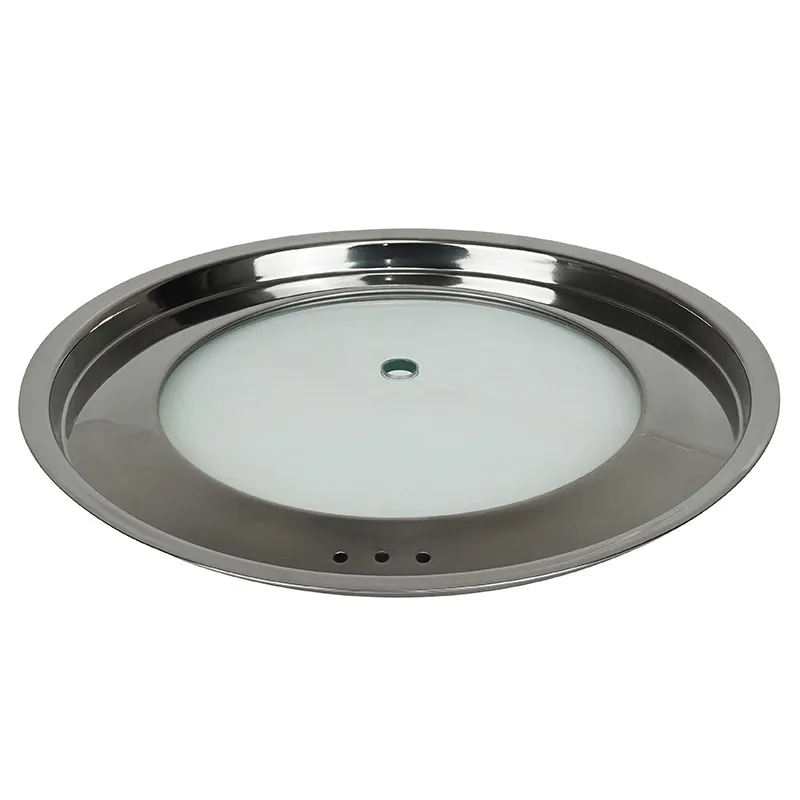
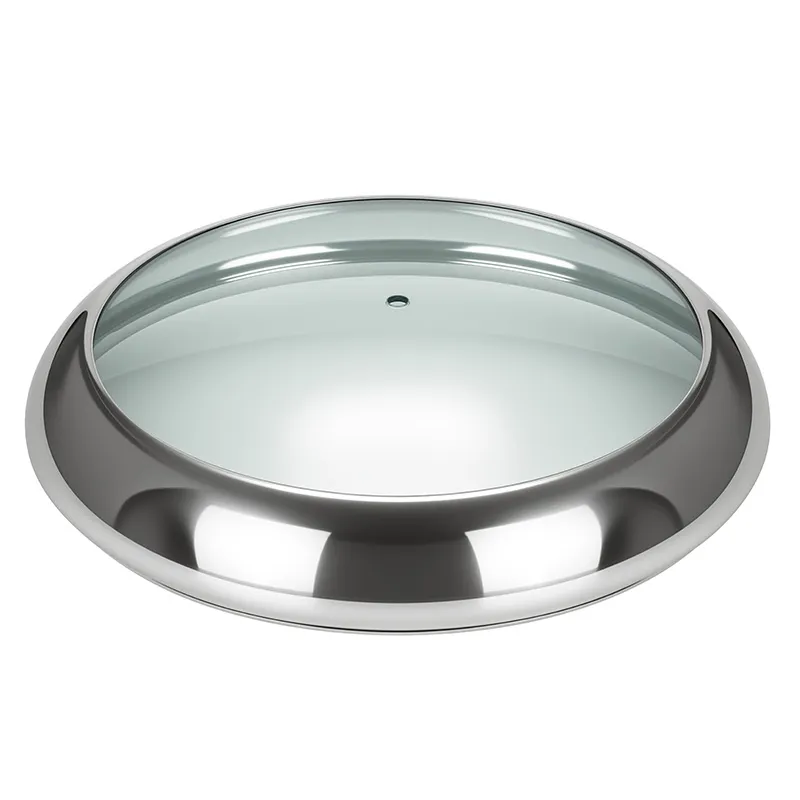
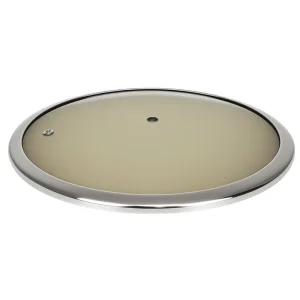
Coverage is the first thing to inspect, and it needs no instruments. Three configurations are common: full wrap, where the ring folds around the edge on both faces; partial wrap, where the ring covers the edge but leaves part of the glass surface exposed; and localized retention, where clips or segments hold the glass at intervals rather than continuously.
Continuous coverage protects the edge uniformly. Segmented retention concentrates stress at the contact points and leaves the sections between them exposed — workable for light decorative lids, less so for lids that will be lifted while loaded, stacked in dish racks, or built at larger diameters. Which configurations a supplier actually offers should be confirmed in writing rather than inferred from a photograph, because one product image can hide very different cross-sections.
Why tempering changes the rim requirement
Tempered glass cannot be cut, drilled or re-shaped after tempering. That single constraint drives most rim decisions: the ring must adapt to a glass disc whose dimensions are already fixed, not the other way round. A glass with flatness variation, or a domed profile, must be matched by a ring that follows that geometry evenly. A ring designed for a flat disc, applied to a domed one, will show uneven contact and localized clamping force — usually invisible on the sample table and obvious six months later.
It also makes “can you make it fit my other pot?” the wrong question for a tempered lid. The glass cannot be re-sized; only the ring, the pot interface or the tooling can change. Buyers who establish this early avoid an expensive assumption late in the project.
Rim Material and Process Differences Buyers Should Compare
Material: ask for a declaration, not a slogan
“Stainless steel” in a quotation is a category, not a specification. Stainless steels differ in corrosion resistance, formability and cost, and those differences surface in a kitchen long before they appear in a price list. Two quotations a few cents apart can describe materially different rings.
The practical fix is procedural: require a written declaration naming the specific grade and the surface treatment, and ask whether a material certificate can be supplied for the batch. A supplier who cannot state the grade in writing is not offering a product you can compare with anyone else’s.
Specific grades and their suitability for food-contact cookware are not asserted here, because the correct answer depends on the supplier’s sourcing and on your target market. Treat the grade as a line item to be named, documented and checked against the certificate.
Forming and joining methods
How the ring holds the glass matters more than what it is made of. At the glass lid manufacturing stage, three families of construction are common, and each moves the risk somewhere different.
- Folded or rolled edge. The ring is formed so its profile wraps the glass edge. The joint is a seam rather than a discrete weld. Risk concentrates in seam tightness and in whether the fold closes consistently around the full circumference.
- Pressed ring. A pre-formed ring is pressed onto the glass edge. Assembly is fast and the profile is consistent, but retention depends on the fit between ring and glass rather than on the ring’s own geometry.
- Welded or spot-welded ring. A ring is closed by welding. Joints are localized, and weld points plus the heat-affected zone around them become the places where corrosion and cracking typically begin.
None of these is universally better. The useful questions are which construction a supplier uses, what the joint looks like after finishing, and how consistent it is across a production run rather than across the single sample you were sent. Where a joint is visible, compare ten pieces instead of one: consistency is the tell.
Surface finish, corrosion risk and cleaning behavior
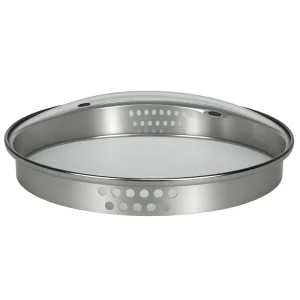
Finish affects appearance and service life together. Polished surfaces shed residue and wipe clean more easily; brushed surfaces hide scratches but retain more in micro-grooves. Either is acceptable. What is not acceptable is a finish that leaves an open seam or an unpolished interior where the ring meets the glass.
Moisture, detergent residue and a narrow crevice is the combination that produces rust spots on stainless parts. Gaps between ring and glass, poorly closed seams and unpolished weld areas are therefore functional defects, not cosmetic ones — they mark where corrosion will appear first. Be conservative with cleaning instructions: do not claim dishwasher suitability for a configuration unless that configuration has been validated.
Decorative finishes such as PVD coatings have their own selection logic and are handled in a separate guide; the relevant point here is that a coating changes the corrosion and wear picture and should be confirmed against the base material underneath.
Failure modes buyers actually see
Complaints about rimmed lids cluster into four patterns. Each has a probable process origin and a specific inspection action.
| What the buyer sees | Probable origin (confirm per supplier) | How to catch it before shipping |
|---|---|---|
| Ring moves or rotates on the glass | Insufficient or uneven clamping; ring-to-glass fit too loose | Twist and press the ring by hand on multiple pieces; check for movement at several points around the circumference |
| Rust spots at the joint or seam | Unpolished or open seam; crevice retains moisture and detergent | Inspect seams with magnification after a wash-and-dry cycle; look inside the ring, not only at the outer face |
| Cracking or separation at a joint | Weld quality, heat-affected zone, or stress from an uneven fold | Visual and dimensional check of joints across the lot; confirm the joining method in writing |
| Chipped or damaged glass edge | Ring coverage too narrow, or packaging allowing edge contact in transit | Inspect edges on arrival, and review the packaging’s edge protection directly |
Treat origins as probable rather than certain. Attributing a failure to a specific process without the supplier’s production data is guesswork, and suppliers who can explain the mechanism are usually the ones who can also fix it.
Sealing and Fit: How the Ring Interacts with the Pot
Seating geometry: overlap, inset and the effect on steam
Two seating families dominate. An overlap design rests a flange on top of the pot rim, and the lid is located by its own width and the pot’s outer edge. An inset design places part of the ring inside the pot opening, so the lid is located by the pot’s inner diameter.
Overlap designs are forgiving of pot rim variation and easy to lift, but they rely on width and weight for stability and can slide when the pot is tilted. Inset designs locate more firmly and sit lower, but they are sensitive to the pot’s inner diameter and to ovality, and they can bind when the fit is too tight. Neither is “sealed” in the gasket sense; both control steam by restricting the escape path between ring and pot rim.
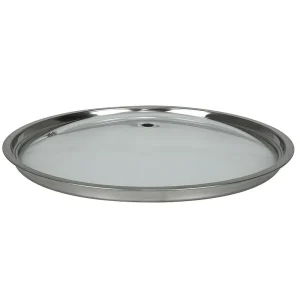
Venting belongs with this decision even though it is usually treated as a lid detail. A vent hole, a gap in the seating profile or a deliberate clearance all change how much steam escapes and where condensation forms, and all of them interact with the seating surface. On a glass lid for cookware, the vent and the ring should be specified together.
The tolerance chain that decides whether it fits
“Same diameter” is where most fit problems begin. A rimmed lid is a chain of five dimensions, and any one of them can consume the clearance intended for another:
- Glass outer diameter — fixed after tempering.
- Ring inner dimension (clamping fit) — must match the glass, not the pot.
- Ring outer or seating dimension — determines how the lid sits.
- Pot inner diameter and rim thickness — the cookware-side input, often the least controlled variable.
- Resulting clearance between lid and pot — the dimension the user actually experiences.
Because steps three and five sit downstream of steps one and two, a lid that measures correctly against the drawing can still fit badly on the pot. Approve the assembly, not the components: verify the glass-and-ring unit against the cookware it will ship with, using the same pot the end customer will use.
Clearance and tolerance values depend on your pot roundness, ring geometry, lid weight and product line. They belong on the drawing, agreed in writing and measured at inspection — not adopted from a template or a website.
Handle and knob loads through the ring
Where the handle is fixed decides where the load goes. If the handle is mounted on the glass, the glass carries the load and the ring’s job is edge protection, with the mounting area as the critical zone. If the handle is mounted on the ring, the load passes through the ring’s clamping and the ring-to-glass interface, so clamping consistency becomes a safety-relevant property rather than a comfort detail.
Both arrangements are used commercially. What matters is knowing which one you are buying, because it changes what you inspect: for glass-mounted handles, check the mounting area and glass condition; for ring-mounted handles, check clamping, joint integrity and pull strength. Handle materials and shapes are a separate subject and are not covered here.
Stainless Steel Ring vs Silicone Rim: Structure Comparison
The comparison is about fitting the application, not about picking a winner. Both structures are legitimate, and the right choice depends on the pot, the user and the service model.
Sealing behavior and steam control
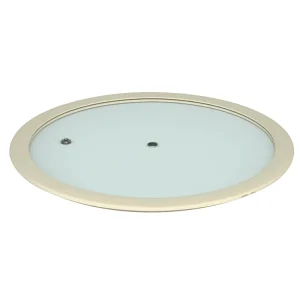
A stainless ring seals by geometry: surfaces meet, clearances restrict flow, and stability comes from mass and fit. A silicone rim seals by elasticity: the gasket conforms to the pot rim and absorbs small irregularities. On a pot with a flat, consistent rim, both work well. On a pot with variation, the elastic gasket is more forgiving and the metal ring is more dependent on the pot being right.
Heat, cleaning and service life
Metal rings tolerate high heat and harsh cleaning better than elastomers, and they do not age the way gaskets do. Silicone rims handle thermal cycling well within their rated range but are consumables: they harden, take on odor and eventually need replacement. Where a lid is used and washed under commercial conditions — high heat, dish racks, frequent cycles — the metal structure’s tolerance for that treatment is a genuine advantage. In home use, where cleaning is gentler, the difference is smaller than marketing usually suggests.
Cost structure and replacement model
A ring is a structural component of the lid; a gasket is a wear part. That changes the economics. A ringed lid is a single purchase whose cost sits in material, forming and assembly. A silicone-rimmed lid may be cheaper to build but implies a replacement path if the gasket is user-replaceable. Brand programs should decide deliberately whether they want a lid that never needs service or a lid with a serviceable wear part. Both are defensible; drifting into one without planning for it is not.
Application fit matrix
| Application | Stainless steel ring | Silicone rim |
|---|---|---|
| Open flame and high heat | Preferred — no elastomer to age | Depends on the gasket’s rated temperature; confirm |
| Electric slow cooking, low moisture loss | Workable; geometry-dependent | Often preferred for conforming fit |
| High-frequency commercial washing | Preferred — better abuse tolerance | Gasket aging accelerates |
| Low-cost high-volume programs | Depends on forming and assembly cost | Usually lower build cost |
| Premium exterior appearance | Strong — finish options are wide | Limited to gasket color and profile |
| Programs needing replaceable wear parts | Not applicable | Preferred |
The matrix describes structural tendencies, not validated performance for a specific SKU. Check it against the actual pot, cleaning regime and service model of the program in front of you.
Dimensions and Tolerances to Check Before Ordering
A tempered glass lid with stainless steel ring is defined by fewer numbers than its appearance suggests — but the few that matter interact, and getting them individually right does not guarantee a lid that fits.
Glass diameter, thickness and what thickness changes
Diameter drives seating geometry and the ring’s circumference; thickness drives stiffness, weight and how much clamping the ring must provide. A thicker glass resists deflection but adds weight that the ring and handle must carry. A thinner glass needs more consistent support. Thickness is also the parameter most often reduced to a single figure in a catalogue, and a catalogue figure is a claim to confirm on the drawing and on the delivered sample — not a specification to order against.
Ring height and glass inset
Ring height and the depth to which the glass sits inside the ring together determine the visible gap between lid and pot, the lid’s overall height, and how much glass edge is protected. A shallow inset exposes more edge; a deep inset protects more but can trap moisture if the interior is not finished properly. These two dimensions are also where appearance and function collide, so agree them together rather than adjusting one late in the project.
Round and square lids: which dimensions change
The principles above hold for any shape, but the measurements do not carry over unchanged.
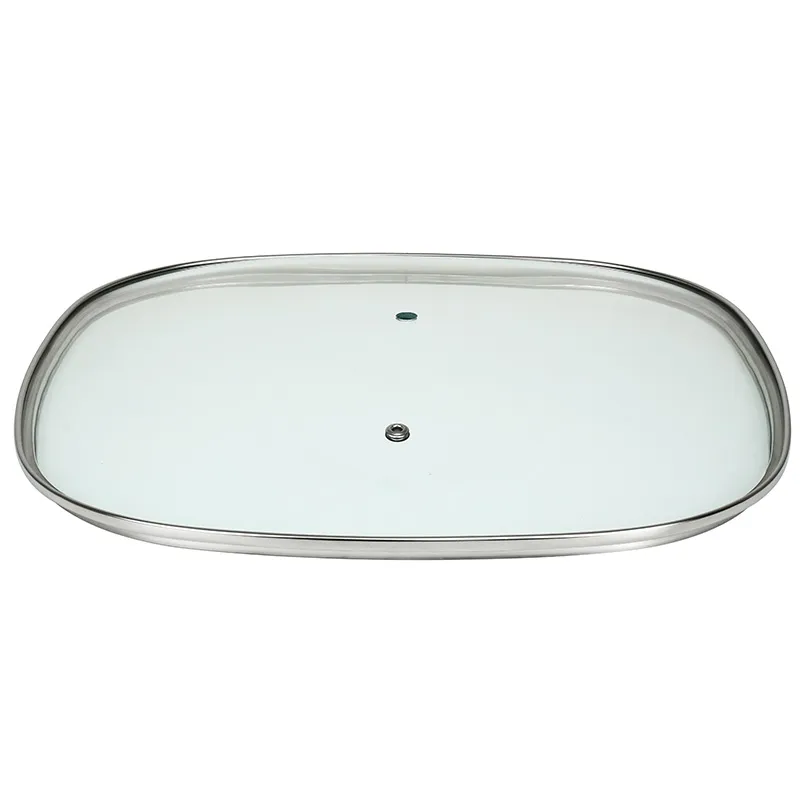
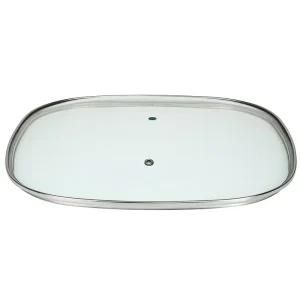
On a round glass lid, a single diameter at the seating plane is the controlling dimension, and roundness deviation across the opening is the main hidden risk. On a square glass lid, diameter gives way to two axis dimensions plus corner radius, and the diagonal becomes the dimension that decides whether the lid clears the opening. Corner radius matters because the corners are where a ring’s clamping is hardest to keep uniform and where glass edge exposure is most likely.
The consequence for buyers is practical: for square programs, specify the two axes, the corner radius and the diagonal, and check all four corners in assembly. Approving a square lid on one axis dimension alone is a reliable way to receive a lid that will not seat.
Verification method: drawing, gauge, sample
Three levels of verification, in this order, catch nearly all fit problems before volume production.
- Drawing. Confirm critical dimensions and tolerances in writing, including which dimensions are controlled and how they are measured. Verbal agreement is not verification.
- Gauge. Measure delivered samples with calipers or a dedicated gauge at the agreed points and record the results. This is where you learn whether the drawing and the parts agree.
- Assembly. Seat the lid on the actual pot: empty, with water, tilted, and lifted by the handle. Assembly reveals interactions that dimensional inspection cannot — binding, rocking, exposed edges, handle flex.
Buyers who approve on drawings alone discover fit problems in a container.
Cookware-side checks buyers often skip
The lid is only half the assembly. Before finalizing, confirm on the cookware side:
- Inner diameter at the seating plane, not at the widest point.
- Rim thickness and rim profile — flanged or straight — since these change the seating surface.
- Ovality or roundness deviation of the pot opening.
- Lid weight relative to the pot, and handle position, since a heavy lid on a small pot behaves differently from a light lid on a wide one.
These inputs are often treated as the cookware supplier’s problem. In practice they are the most common source of “the lid doesn’t fit” complaints, and they cost nothing to measure.
Purchasing and Inspection Checklist
RFQ data sheet: what to send the supplier
Send parameters, not pictures. A complete RFQ prevents the most common failure: a glass lid supplier quoting against an interpretation of your photo.
| Item | What to state |
|---|---|
| Pot interface | Inner diameter at seating plane, rim thickness, rim profile |
| Glass | Diameter or axes plus corner radius, thickness, flat or domed, edge condition required |
| Ring | Material grade (declared in writing), surface treatment, outer dimension, height, seating style |
| Retention | Continuous wrap, partial wrap or localized retention |
| Handle | Type, material, and whether mounted on glass or on ring |
| Venting | Vent present or not, position, expected steam behavior |
| Compliance | Target market, plus the specific requirements that apply there — agreed in writing by both parties |
| Documentation | Material certificate, inspection report, sample quantity |
| Packaging | Inner protection at the glass edge, carton configuration, drop-test expectations |
| Commercial | Sample lead time, production lead time, MOQ, price basis |
Sample validation before mass production
Validate a sample against four things: fit on the real pot, edge and joint condition, corrosion behavior under an agreed method, and mechanical robustness under an agreed test.
Corrosion and impact testing should reference a method you and the supplier have agreed on, and the results should come from the test report rather than from an assumption about the material. If reports exist, ask for them and check that the tested configuration matches the configuration you are ordering — same construction, same finish, same dimensions.
Mass-production inspection points
| Inspection point | Method | Judgement basis |
|---|---|---|
| Ring retention | Manual twist and press at several points per piece | No movement beyond the agreed allowance |
| Seam and joint appearance | Visual, with magnification at joints | Closed, finished, free of open crevices |
| Corrosion | Wash-and-dry cycle, then inspect seams and interior | No rust spots at joints or crevices |
| Critical dimensions | Caliper or gauge at drawing-defined points | Within drawing tolerance |
| Handle attachment | Pull or torque test per agreed method | Meets the agreed value |
| Glass edge condition | Visual inspection of edge and ring coverage | No chips, no exposed edge beyond the design |
| Packaging | Review of edge protection and carton structure | Protects edges through the agreed drop test |
Sampling plans and acceptance quality limits are commercial terms, not technical defaults. Set them in the purchase contract with your supplier rather than adopting a number from a template, and make sure both parties interpret the same defect classes the same way.
Supplier capability signals
Capability shows up in process control, not in brochures. Useful signals: a supplier can walk you through the forming, joining, finishing and assembly steps in order; tooling and gauges are in-house rather than borrowed for the visit; material certificates trace to the batch you are buying; and there is a documented path from complaint to corrective action. A supplier who assembles purchased rings onto purchased glass can still be a good partner, but you should know which processes are theirs and which are not, because that determines who owns a quality problem when it appears.
FAQ
Is a stainless steel ring stronger than a silicone rim?
Not in a way that can be stated as a general rule. A ring is stronger in heat tolerance, cleaning abuse and dimensional stability; a silicone rim is more forgiving of pot rim variation and provides elastic sealing. “Stronger” is the wrong axis — fit the structure to the pot, the cleaning regime and the service model.
Why does the rim rust while the glass looks fine?
Glass and stainless steel fail independently. Rust on a stainless part typically starts where moisture and detergent residue persist: an open seam, an unpolished joint, a narrow crevice between ring and glass. It is usually a finishing and geometry issue rather than a material issue, and it is visible at inspection if you look inside the ring rather than only at its face.
Can a tempered glass lid be re-drilled or re-sized for a different pot?
No. Tempered glass cannot be cut or drilled after tempering. A lid that does not fit requires a change to the ring, the seating interface or the tooling — or a different lid — not a modification of the glass.
How much clearance should there be between the ring and the pot edge?
No single number works across designs. Clearance is set by pot roundness, ring geometry, lid weight and whether the design vents deliberately. Fix the value on the drawing with your supplier, then verify it by seating the lid on the actual pot.
Does the ring affect whether the lid can go in a dishwasher?
It can. Dishwasher environments combine heat, moisture and alkaline detergent, which is exactly the combination that finds weak seams. Whether a specific configuration is suitable depends on the materials, the finishing of joints and any coating. Treat dishwasher suitability as something to be validated for your configuration rather than assumed from the base material.
Can the ring material and finish be customized for a brand program?
Material, finish and profile can generally be varied within a supplier’s process capability, and customized glass cover programs regularly change all three. The viable range, however, depends on tooling and volume. Confirm what is actually available for your quantity and diameter before building a brand specification around it.
Conclusion: Match the Rim to the Pot, Not to the Photo
A tempered glass lid with stainless steel ring is a small assembly with three interfaces that each fail in their own way. The ring protects a glass edge that cannot be repaired, clamps the lid into one load-bearing unit, and defines how the lid meets the pot. Material and process decisions set the corrosion and durability baseline; the tolerance chain decides whether the lid fits at all; inspection decides whether the shipped batch matches the sample you approved.
Three habits prevent most of what is described here. Specify the assembly, not the components. Verify fit on the real pot, not on a drawing. Inspect seams, joints and edges across a sample size that shows consistency rather than on one perfect piece.
If you are selecting a rimmed lid for a cookware program, the fastest route to a reliable answer is to send your pot interface dimensions, target market requirements and expected volumes — then evaluate samples against the checks above rather than against photographs.