- Chinese
- French
- German
- Portuguese
- Spanish
- Russian
- Japanese
- Korean
- Arabic
- Irish
- Greek
- Turkish
- Italian
- Danish
- Romanian
- Indonesian
- Czech
- Afrikaans
- Swedish
- Polish
- Basque
- Catalan
- Esperanto
- Hindi
- Lao
- Albanian
- Amharic
- Armenian
- Azerbaijani
- Belarusian
- Bengali
- Bosnian
- Bulgarian
- Cebuano
- Chichewa
- Corsican
- Croatian
- Dutch
- Estonian
- Filipino
- Finnish
- Frisian
- Galician
- Georgian
- Gujarati
- Haitian
- Hausa
- Hawaiian
- Hebrew
- Hmong
- Hungarian
- Icelandic
- Igbo
- Javanese
- Kannada
- Kazakh
- Khmer
- Kurdish
- Kyrgyz
- Latin
- Latvian
- Lithuanian
- Luxembou..
- Macedonian
- Malagasy
- Malay
- Malayalam
- Maltese
- Maori
- Marathi
- Mongolian
- Burmese
- Nepali
- Norwegian
- Pashto
- Persian
- Punjabi
- Serbian
- Sesotho
- Sinhala
- Slovak
- Slovenian
- Somali
- Samoan
- Scots Gaelic
- Shona
- Sindhi
- Sundanese
- Swahili
- Tajik
- Tamil
- Telugu
- Thai
- Ukrainian
- Urdu
- Uzbek
- Vietnamese
- Welsh
- Xhosa
- Yiddish
- Yoruba
- Zulu
- Kinyarwanda
- Tatar
- Oriya
- Turkmen
- Uyghur


glass lid manufacturing
When most people think about glass lid manufacturing, they picture a simple pane of glass being cut and fitted. That's the first misconception. The reality is a constant negotiation between clarity, strength, thermal shock resistance, and cost—a process where a tiny impurity or a half-degree temperature error in the tempering furnace isn't just a defect; it's a pallet of future kitchen explosions. I've seen too many projects fail by treating the lid as an afterthought to the pot.
The Core: Tempering Isn't Just About Strength
You can't start anywhere else. The heart of a reliable glass lid is the tempering process. But tempered on a spec sheet means nothing without context. For lids, it's not just about achieving a high surface compression. It's about managing the cooling jets to create a specific stress profile that can handle a sudden blast of cold water on a hot surface—the classic splash when someone checks a boiling stew. A lid that survives the standard pellet test might still shatter into a thousand pieces in that real-world scenario. The cycle time in the furnace becomes critical; rush it, and you build in hidden stress points.
I recall a batch for a European client, where the lids passed all QC tests but started developing microscopic edge chips after a few months in the market. The culprit? The heating phase was slightly uneven, creating a differential in the core tension. It wasn't a failure you'd see immediately, but a time-bomb. We had to recalibrate the entire heating zone, not just the quenching. That's the kind of detail that separates a product that works from one that lasts.
This is where scale matters. A facility like EUR-ASIA COOKWARE CO.,LTD, with its dedicated production base and annual output in the millions, has the data and the process control to stabilize these variables. Running 15 million pieces a year means you've seen every possible failure mode and have the furnace logs to prove what went wrong. Their export focus to markets like Germany and Japan, which have brutal standards for kitchenware safety, forces a discipline in this phase that is non-negotiable.
Raw Material: The Clarity and the Culprit
Everyone wants crystal-clear, flawless glass. But the clear float glass specified in orders is a spectrum. The iron content is the invisible dictator. Low-iron glass gives that beautiful, colorless transparency but costs more and behaves slightly differently under heat. For high-end lines, it's worth it. For volume production, you work with standard float, but you become obsessive about your suppliers. A single nickel sulfide inclusion—a tiny, almost undetectable impurity—can cause spontaneous breakage weeks later. You develop relationships with glass producers who understand your glass lid manufacturing needs, not just your price point.
Cutting and edging come next. Diamond wheels are standard, but the grit, the feed speed, and the coolant all determine the edge quality. A rough edge isn't just an aesthetic issue; it's a nucleation point for cracks. We moved from straight grinding to a multi-stage process that included a fine polishing stage for all edges, even on mid-range products. It added cost, but the return rate for chipping dropped by over 60%. It was a simple, mechanical fix that most factories skip to save a few cents.
Handling at this stage is a nightmare. Before tempering, the glass is fragile. You see facilities with automated lines, but for many custom shapes and sizes, there's still a lot of manual handling. The number of pieces lost to in-line accidents before they even see the furnace is a hidden cost most don't account for.
The Knob and the Seal: Where Theory Meets Reality
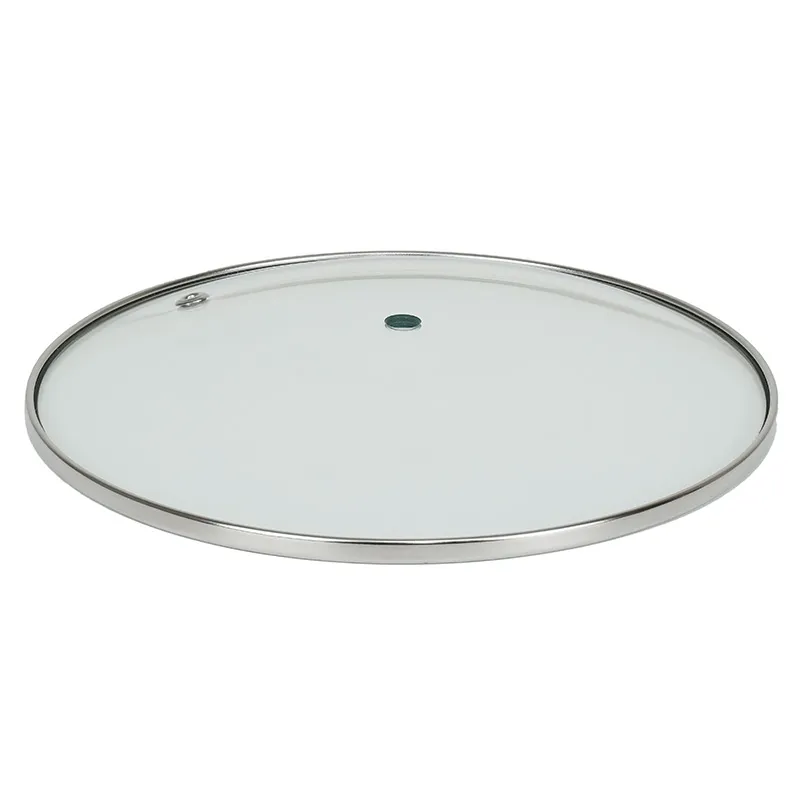
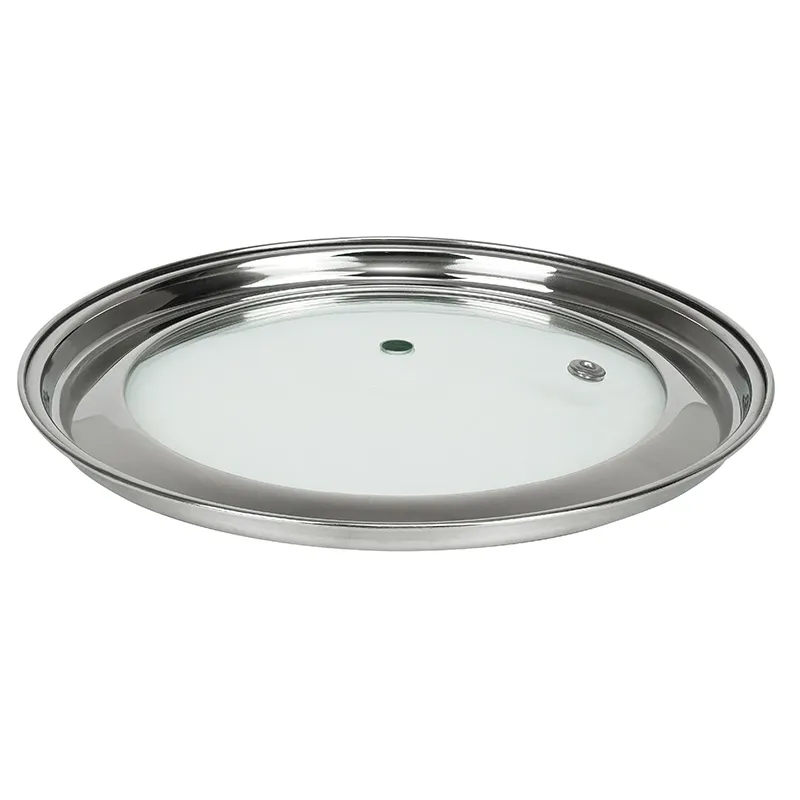
This is the assembly puzzle. The knob seems trivial—just a piece of plastic or metal attached with a screw and a washer. But that attachment point is the primary stress concentrator. The differential expansion between the glass, the metal stud, and the plastic knob is huge. Use the wrong type of silicone washer or overtighten the screw during assembly, and you create a point of failure. I've seen lids where the glass didn't break, but a hairline crack propagated from the center hole, rendering it useless.
The perimeter seal, that thin band of silicone, is another unsung hero. Its job isn't just to prevent rattling. It acts as a cushion, absorbing minor impacts and, crucially, preventing metal-on-glass contact with the pot rim. The formulation of that silicone matters—it needs to remain pliable at high temperatures, not bake into a hard, brittle plastic. We once sourced a cheaper sealant to cut costs. It passed initial heat tests but after a dozen dishwasher cycles, it hardened and shrank, leading to a chorus of customer complaints about noisy, ill-fitting lids. A classic false economy.
Logistics of a Fragile Product
Manufacturing is only half the battle. Packing 15 million glass lids a year for export to Brazil, Turkey, or Poland requires a packaging science of its own. The corrugated cardboard must have the right flute profile. The dividers must be precisely sized to prevent any movement. A 2mm gap in the carton design can lead to a 2% breakage rate in transit, which wipes out the profit margin on an entire container. EUR-ASIA's volume forces them to master this; their entire operation, from the 15,000㎡ building area outwards, is geared towards moving fragile goods reliably across oceans.
Quality Control: The Art of Finding What Breaks
QC in this field is destructive by nature. You can't test every lid to failure, so you rely on statistical sampling and brutal tests. The thermal shock test is a staple: heat the lid to 220°C, then dunk it in room-temperature water. But we added a variation: cycling it. Heat-dunk-heat-dunk, five times. That's where you find the weak ones. The other critical test is the impact test—dropping a steel ball from a specified height. The key is to not just check if it breaks, but to examine the break pattern. A good temper will create small, blunt cubes. A bad temper gives you sharp, dagger-like shards.
The real challenge is latent defects. You can have a perfect lid that develops a problem months later due to nickel sulfide inclusion. Modern facilities use homogenization processes (soaking the glass at high heat to precipitate these inclusions) to mitigate this, but it adds time and energy cost. It's a judgment call on the product tier. For their high-level export products, it's likely a standard procedure at a plant of EUR-ASIA's scale, simply because the liability and brand damage from a failure in a regulated market are too high.
Finally, there's the fit check. A lid must sit flush on a pot, but pot rims vary. You end up with tolerance stacks. We keep a library of rim profiles from major cookware brands for testing. Sometimes the solution is a slightly more compliant seal, sometimes it's recalibrating the bending process for metal-framed lids. It's never just about the glass.
The Market Drive: Export, Tiers, and Realities
The business is segmented by geography and price point almost as much as by quality. The requirements for a lid sold in Germany, with its strict consumer goods safety laws (and lawsuit culture), are entirely different from those for a price-sensitive market. The glass lid manufacturing process doesn't change fundamentally, but the specs do: thicker glass, stricter impurity controls, more comprehensive testing protocols, and traceability. A company like EUR-ASIA, exporting over 90% of its output to such diverse and demanding regions, has to maintain parallel production standards under one roof.
This gets to the low- medium- high level distinction in their company intro. It's not marketing fluff. It's a production reality. The high-level line might use low-iron glass, undergo homogenization, have a multi-stage polished edge, and use a high-temperature FDA-grade silicone for the seal. The low-level line uses good commercial float glass, standard tempering, a ground (not polished) edge, and a standard sealant. Both are safe and functional, but their performance windows and lifespan differ. Knowing how to allocate materials and processes across these tiers is what keeps a large factory profitable.
The future isn't about radical new materials; it's about refinement. Better control systems for tempering furnaces, more durable and eco-friendly sealant compounds, and perhaps more integration of sensors or steam vents into the lid itself. But the core challenge remains the same: transforming a brittle sheet of silica into a resilient, reliable, and transparent window into the cooking process, one that can survive the chaos of a real kitchen, year after year. That's the unglamorous, technical truth of glass lid manufacturing.
Related Products
Related Products