- Chinese
- French
- German
- Portuguese
- Spanish
- Russian
- Japanese
- Korean
- Arabic
- Irish
- Greek
- Turkish
- Italian
- Danish
- Romanian
- Indonesian
- Czech
- Afrikaans
- Swedish
- Polish
- Basque
- Catalan
- Esperanto
- Hindi
- Lao
- Albanian
- Amharic
- Armenian
- Azerbaijani
- Belarusian
- Bengali
- Bosnian
- Bulgarian
- Cebuano
- Chichewa
- Corsican
- Croatian
- Dutch
- Estonian
- Filipino
- Finnish
- Frisian
- Galician
- Georgian
- Gujarati
- Haitian
- Hausa
- Hawaiian
- Hebrew
- Hmong
- Hungarian
- Icelandic
- Igbo
- Javanese
- Kannada
- Kazakh
- Khmer
- Kurdish
- Kyrgyz
- Latin
- Latvian
- Lithuanian
- Luxembou..
- Macedonian
- Malagasy
- Malay
- Malayalam
- Maltese
- Maori
- Marathi
- Mongolian
- Burmese
- Nepali
- Norwegian
- Pashto
- Persian
- Punjabi
- Serbian
- Sesotho
- Sinhala
- Slovak
- Slovenian
- Somali
- Samoan
- Scots Gaelic
- Shona
- Sindhi
- Sundanese
- Swahili
- Tajik
- Tamil
- Telugu
- Thai
- Ukrainian
- Urdu
- Uzbek
- Vietnamese
- Welsh
- Xhosa
- Yiddish
- Yoruba
- Zulu
- Kinyarwanda
- Tatar
- Oriya
- Turkmen
- Uyghur


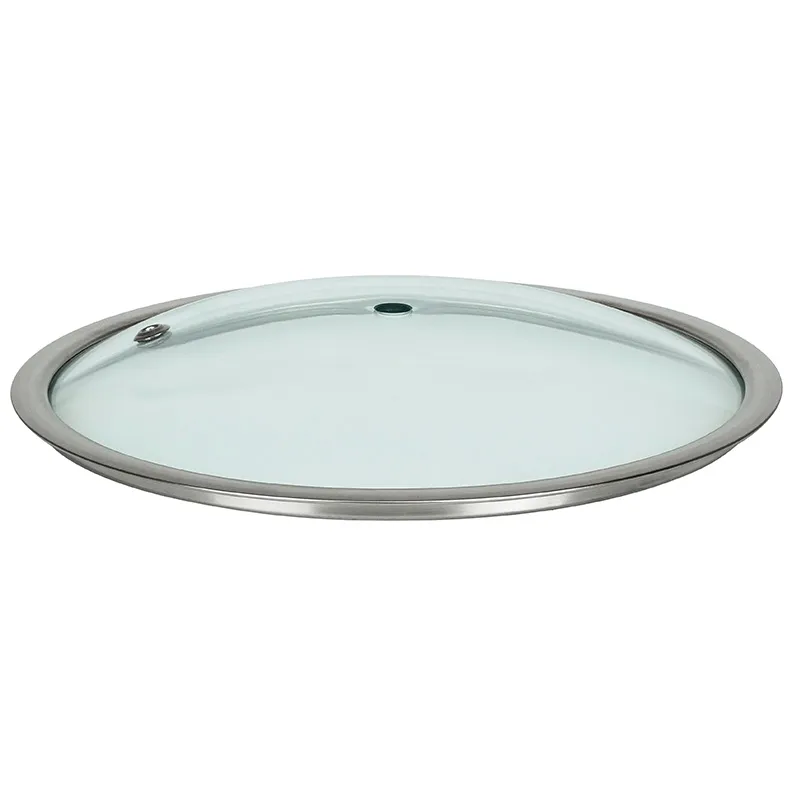
lodge 12 inch tempered glass lid
You search for 'lodge 12 inch tempered glass lid' and you're probably looking for a direct fit for your cast iron. Here's the first reality check: that 12-inch spec is often a nominal, not an absolute, measurement. In our production runs at EUR-ASIA COOKWARE CO.,LTD., a 12-inch lid typically has a true outer diameter of around 305mm to 310mm (about 12.2 inches) to account for the flange. If your Lodge skillet's top outer edge measures a true 12 inches (304.8mm), a nominal 12-inch lid might sit inside the rim, not on it, causing stability issues. This mismatch is where most generic replacements fail.
The Manufacturing Nuance Behind a Simple Lid
Producing a tempered glass lid isn't just about cutting a circle and heating it. For a lid meant to withstand the thermal shock of a heavy cast iron pan like Lodge's, the tempering process is critical. We run at a higher temperature and use a more aggressive quench for lids destined for the US market, particularly for cast iron compatibility. The stress pattern, visible under polarized light, needs to be uniform. A weak pattern, often from uneven air jets in the tempering furnace, leads to spontaneous breakage—not from impact, but from internal stress fighting the heat gradient of a searing hot pan.
I recall a batch for a European client where we missed the mark. The lids passed standard impact tests but showed a concentric stress pattern. In real-world use, about 3% failed when placed on a hot, dry pan. The failure mode was a classic dice fracture from the center. The root cause? An airflow calibration error in the furnace for that run. It wasn't a material defect; it was a process deviation. That's the hidden variable in glass lid quality.
The handle is another point of failure. The stainless steel bail handle, common on Lodge-style lids, isn't just glued. The bond relies on a high-temp silicone gasket set into a machined groove on the glass. We've moved away from purely adhesive methods. The thermal expansion rates of glass and metal differ drastically. A rigid adhesive will crack the glass around the mounting point over repeated cycles. You can check this on a well-used lid—look for micro-cracks radiating from the handle base.
Fit and Function: The Lodge-Compatible Minefield
Many resellers label lids as fits Lodge 12-inch. From our OEM experience, Lodge's own skillet dimensions have subtle variations between classic lines and newer models. The bevel on the skillet's rim matters. Our standard 12-inch lid design for export, like those we produce for partners in Germany and Poland, has a beveled underside edge. This creates a kind of seating effect. A flat-bottomed glass lid will rock on a slightly convex skillet rim. It's a tiny detail you only notice when you try to simmer a sauce and see the lid tremble with each bubble.
We supply to distributors who private-label for hardware chains. They often request a universal fit 12-inch lid. This usually means a slightly smaller true diameter and a thicker silicone gasket around the edge. It works, but poorly. It traps too much steam, can pop off from pressure, and the condensation drip pattern is erratic. A proper fitted lid should have a consistent 2-3mm gap around the skillet's inner wall. That's the sweet spot for moisture control. You can find some of our technical specs and standard dimension sheets on our site, glass-lid.com, which details our production capabilities for these kinds of precision items.
The knob temperature rating is another oversold feature. A phenolic knob rated to 350°F is useless on a cast iron lid that can hit 500°F+ at the center. We use metal-core knobs with a thick phenolic insulator underneath. Even then, we instruct clients that the knob is for lifting a cooling lid, not for adjusting a boiling one. Always use a dry cloth. This is basic, but you'd be surprised how many warranty claims stem from melted knobs.
Case in Point: The EUR-ASIA Production Floor Perspective
At our Taian facility, a line dedicated to 12 inch tempered glass lid production runs about 20,000 pieces a month. The critical inspection point isn't final packaging; it's after tempering and before handle assembly. Each lid is viewed through polarizing filters by experienced line workers—machines still miss subtle stress anomalies. These workers are looking for the tell-tale butterfly or angel wing patterns that indicate a future breakage risk.
Export quality demands are divergent. For the South Korean and Japanese markets, the focus is on flawless optical clarity and pristine edge grinding—aesthetic perfection. For the European and North American markets, the demand is purely structural and safety-focused. The same tempered glass lid from the same mold gets different QC thresholds. Our shipments to Germany, for instance, require batch testing documentation showing thermal shock resistance from 0°C to 300°C. A domestic market lid might only be tested to 250°C. It's the same product, but the validated data is different.
Material sourcing is key. We use float glass from specific suppliers with tight control over iron content. Lower iron content gives clearer glass, but it also affects the tempering curve. A high-iron glass heats differently. For a lid, clarity is secondary to thermal performance. We prioritize a consistent, predictable heating profile in the furnace over absolute crystal clarity. That's why some premium lids look slightly green at the edge (the iron tint), yet outperform optically perfect ones.
Practical Failures and Field Observations
I've seen lids fail in the field. One common, non-obvious failure is edge chip propagation. A tiny chip from tapping the skillet rim, almost invisible, can become a fracture line after a few heat cycles. Tempered glass is under immense surface compression. Breach that compressed layer, and the tension underneath is released catastrophically. It doesn't always happen immediately. It might happen on the third use. That's why we now roll the edges more aggressively than we did five years ago—creating a thicker compression layer at the most vulnerable point.
Another issue is cold lid on a hot, wet pan. Everyone knows not to place a cold lid on hot, dry glass. But a pan with a thin layer of water or sauce is more dangerous. The liquid creates an instantaneous and perfect thermal contact, transferring heat to the cold lid far faster than air or even dry glass could. This causes a severe localized thermal shock. The result is often a starburst crack originating from the point of liquid contact. The manual should say: Warm the lid gently before placing it on any hot pan. But who reads the manual for a lid?
Cleaning is the final destroyer. Abrasive scrubbers on the glass top are fine. The problem is cleaning the underside. Burnt-on grease gets scrubbed with steel wool or harsh abrasives against the handle mounting points and the edge. This microscopically damages the surface, creating thousands of stress concentrators. The lid might survive 100 cycles, then shatter in the 101st from a perfectly normal heating. We recommend citric acid or baking soda paste soaks for underside cleaning. It's not about being gentle; it's about preserving the integrity of the tempered surface.
Concluding Without a Bow: The Unsexy Truth
So, back to the original search term. A true lodge 12 inch tempered glass lid isn't a commodity. It's a component engineered for a specific thermal and mechanical environment. The company EUR-ASIA COOKWARE CO.,LTD. produces millions of these, and the nuance is in the process control, not the marketing copy. When you evaluate one, don't just measure the diameter. Look at the edge finish. Feel the weight of the handle assembly. Check for a slight bevel on the seating surface.
The real test is in use. A good lid will sit stable, condense evenly, and its knob will remain cool enough to touch briefly after 15 minutes of simmering. It won't be perfect. You might get some rocking if your skillet is warped. That's the reality of mass-produced cast iron and mass-produced glass. The goal is a reliable, safe fit that manages moisture and lets you see your food. Everything else is just specs on a page.
Our annual output of over 15 million pieces for global markets means we've seen every failure mode and success story. The data from the field, from Brazil to Switzerland, feeds back into the tempering curves and edge designs we use today. The next time you lift a glass lid, that simple disk is the product of that continuous, unglamorous iteration. It's not rocket science. It's just applied material science, done carefully, thousands of times a day.
Related Products
Related Products