- Chinese
- French
- German
- Portuguese
- Spanish
- Russian
- Japanese
- Korean
- Arabic
- Irish
- Greek
- Turkish
- Italian
- Danish
- Romanian
- Indonesian
- Czech
- Afrikaans
- Swedish
- Polish
- Basque
- Catalan
- Esperanto
- Hindi
- Lao
- Albanian
- Amharic
- Armenian
- Azerbaijani
- Belarusian
- Bengali
- Bosnian
- Bulgarian
- Cebuano
- Chichewa
- Corsican
- Croatian
- Dutch
- Estonian
- Filipino
- Finnish
- Frisian
- Galician
- Georgian
- Gujarati
- Haitian
- Hausa
- Hawaiian
- Hebrew
- Hmong
- Hungarian
- Icelandic
- Igbo
- Javanese
- Kannada
- Kazakh
- Khmer
- Kurdish
- Kyrgyz
- Latin
- Latvian
- Lithuanian
- Luxembou..
- Macedonian
- Malagasy
- Malay
- Malayalam
- Maltese
- Maori
- Marathi
- Mongolian
- Burmese
- Nepali
- Norwegian
- Pashto
- Persian
- Punjabi
- Serbian
- Sesotho
- Sinhala
- Slovak
- Slovenian
- Somali
- Samoan
- Scots Gaelic
- Shona
- Sindhi
- Sundanese
- Swahili
- Tajik
- Tamil
- Telugu
- Thai
- Ukrainian
- Urdu
- Uzbek
- Vietnamese
- Welsh
- Xhosa
- Yiddish
- Yoruba
- Zulu
- Kinyarwanda
- Tatar
- Oriya
- Turkmen
- Uyghur

How to Evaluate a Glass Lid Manufacturer in China: A B2B Sourcing Guide
2026-11-04
Summary: Learn how to evaluate a glass lid manufacturer in China by checking manufacturing capabilities, product range, customization support, quality control, compliance documentation, export experience, and supplier reliability. This guide also provides a practical factory audit checklist and sample evaluation process for B2B buyers.
Choosing a glass lid manufacturer in China involves more than comparing product catalogs or requesting quotations. For cookware brands, importers, wholesalers, and OEM/ODM buyers, the right supplier should be able to meet product specifications, maintain consistent quality, support customization requirements, and coordinate orders according to agreed terms.
However, not every company advertising itself as a China glass lid factory performs the same manufacturing processes. Some suppliers handle glass processing and product assembly, while others outsource certain production stages or operate primarily as trading companies. These differences can affect quality control, customization, communication, and order management.
Before placing a bulk order, buyers should evaluate a supplier’s actual manufacturing capabilities, product range, technical support, quality management procedures, compliance documentation, and export experience.
This guide explains seven important factors to consider when evaluating a glass lid manufacturer in China. It also provides a practical factory audit checklist, a sample evaluation process, and common sourcing mistakes to help international buyers make more informed purchasing decisions.
1. Why the Difference Between a Glass Lid Manufacturer and a Trading Company Matters
Understanding whether a supplier is a manufacturer or a trading company is an important first step in the sourcing process. Both business types can support international purchasing, but their operating models and responsibilities may differ.
For buyers planning long-term cooperation, customized production, or recurring bulk orders, understanding the supplier’s actual role helps establish realistic expectations.
1.1 What Does a Glass Lid Manufacturer Actually Do?
A glass lid manufacturer is a company involved in producing glass lids or managing specific manufacturing processes. Depending on its production setup, its operations may include glass cutting, edge grinding, polishing, tempering, component assembly, and finished-product inspection.
A manufacturer may also coordinate the sourcing of additional components, such as stainless steel rims, handles, knobs, and other accessories.
However, the term manufacturer does not automatically mean that every production stage takes place in the same factory.
For example, one company may handle glass cutting and assembly internally while outsourcing tempering or certain accessory-processing operations. Another may manage a more extensive production process within its own facilities.
When evaluating a potential supplier, buyers should therefore ask:
- Which production processes are completed in-house?
- Which processes are outsourced to external partners?
- Who is responsible for inspecting outsourced components?
- How are product specifications communicated between different production stages?
- Who takes responsibility for final product quality?
These questions provide a clearer picture of the supplier’s actual manufacturing role than a company profile alone.
1.2 How Does a Trading Company Differ from a Factory?
A trading company generally coordinates purchasing and sales between customers and manufacturing suppliers. It may manage product selection, quotations, order communication, quality coordination, packaging, and shipping arrangements without directly operating the production facilities.
The main differences can be summarized as follows:
| Evaluation Area | Manufacturer | Trading Company |
|---|---|---|
| Production facilities | May operate its own production facilities | Generally relies on external factories |
| Production management | Directly manages its own production or selected processes | Coordinates with manufacturing partners |
| Product customization | Depends on its actual technical capabilities | Depends on cooperation with manufacturing partners |
| Quality control | Can directly supervise its own production stages | Relies on supplier coordination and inspection arrangements |
| Product sourcing | Produces products or manages outsourced processes | Sources products from manufacturing suppliers |
| Communication | May provide access to production personnel | Usually coordinates through its commercial team |
Neither business model is automatically better for every purchasing project.
A trading company may be suitable when buyers need multiple product categories or coordinated sourcing from different factories. A manufacturer may be more appropriate when production transparency, direct technical communication, and control over specific manufacturing processes are priorities.
The important consideration is whether the supplier’s actual business model matches the buyer’s requirements.
1.3 Which Supplier Type Is Suitable for Your Purchasing Needs?
The appropriate supplier depends on the complexity and scale of the purchasing project.
For buyers sourcing standard glass lids in multiple product configurations, a supplier with established sourcing and coordination capabilities may be sufficient.
For cookware brands requiring customized dimensions, handle designs, rim configurations, or private-label packaging, it is important to work with a supplier that can clearly explain how these requirements will be implemented.
For recurring bulk orders, buyers should pay particular attention to production planning, component consistency, quality inspection, and communication between the supplier and its production partners.
Rather than choosing a supplier based only on whether it calls itself a factory, buyers should verify its actual responsibilities and capabilities.
2. Seven Key Factors to Evaluate a Glass Lid Manufacturer in China
When evaluating a glass lid manufacturer in China, buyers should look beyond product appearance and quotations. A reliable assessment should cover manufacturing capabilities, product range, customization support, quality control, compliance documentation, export experience, and communication.
The following seven factors provide a practical framework for comparing potential suppliers.
2.1 Manufacturing Qualifications and Factory Type
The first step is to verify the supplier’s business identity and understand its actual operating structure.
Buyers should not assume that a company has complete manufacturing facilities simply because its website describes it as a professional manufacturer.
Start by requesting basic company information, including:
- Business registration information
- Registered company name and business scope
- Actual factory address, if applicable
- Company and factory profiles
- Production facility photographs or videos
- Equipment lists and manufacturing process descriptions
The registered business address and actual production address should be distinguished when reviewing the information.
During an on-site or remote factory audit, buyers should compare the supplier’s stated capabilities with the production activities that can actually be observed.
It is also important to understand whether the company manages all production stages internally or cooperates with external processing facilities.
For example, if glass tempering is outsourced, buyers should ask how the supplier communicates technical requirements, inspects incoming processed glass, and handles quality problems related to that stage.
A transparent supplier should be able to explain its production arrangements without making unsupported claims about factory ownership or manufacturing capacity.
2.2 In-House Tempered Glass Processing Capabilities
Glass processing is a central consideration when sourcing tempered glass cookware lids.
Different manufacturing stages can affect dimensions, edge quality, surface condition, and the final product’s compatibility with other components.
Buyers should understand how the supplier manages the relevant processing stages, including:
Glass cutting
The supplier should explain how glass sheets are cut according to the required product dimensions and how dimensional consistency is checked.
Edge grinding and polishing
Glass edges require appropriate finishing before subsequent processing and assembly. Buyers should ask how edge conditions are inspected and how visible defects or damage are handled.
Tempering process
Tempering is an important production stage for products specified as tempered glass lids. Buyers should confirm whether this process is completed internally or by an external processing partner.
They should also ask how the supplier monitors the process and maintains traceability between processed glass and finished products.
Dimensional and appearance inspection
Relevant inspection items may include glass diameter, thickness, surface condition, edge quality, and visible defects.
Post-processing and assembly
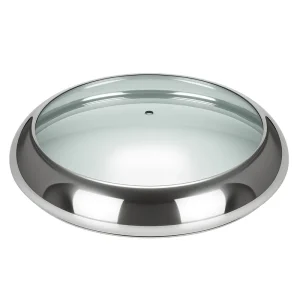
If the glass lid includes a stainless steel rim, handle, knob, or other accessories, buyers should understand how these components are matched and assembled.
A useful evaluation approach is to request a production process overview and discuss each stage with the relevant production or quality personnel.
The goal is not simply to find a factory with a particular machine. It is to determine whether the supplier can consistently manage the manufacturing processes required by the purchasing specification.
2.3 Product Range and Manufacturing Flexibility
A suitable supplier should be able to explain which glass lid configurations it can supply and how its available products relate to the buyer’s application.
Cookware glass lids can differ in several ways:
- Diameter and overall dimensions
- Glass thickness
- Round or square shapes
- Flat or dome-shaped profiles
- Stainless steel or other rim configurations
- Handle and knob designs
- Steam vent arrangements
- Edge and assembly structures
For example, a cookware brand may need several lid diameters for different frying pans and cooking pots. Another buyer may require a specific rim configuration or handle design to match an existing cookware series.
These requirements make product compatibility important.
When evaluating a China glass lid manufacturer, buyers should request a product catalog or specification sheet and compare the available configurations with their actual requirements.
However, a broad catalog alone does not prove that every listed product is manufactured in-house. Buyers should confirm the production source and customization arrangements for the specific products they intend to purchase.
2.4 Customization and OEM/ODM Capabilities
Customization is particularly important for cookware brands and private-label buyers.
A standard glass lid may meet basic functional requirements, but branded cookware projects often require more specific dimensions, component combinations, product appearance, and packaging.
Before selecting a glass lid supplier, buyers should evaluate its ability to work with technical drawings, reference samples, and customized specifications.
Important customization areas include:
Product dimensions
Confirm whether the supplier can work according to the required diameter, glass thickness, and dimensional specifications.
Glass and rim configurations
Discuss the required glass profile, edge treatment, and rim material or construction.
Handle and knob designs
Confirm the available handle options and whether customized designs or component combinations can be supported.
Steam vent requirements
If a steam vent is required, clarify its position, design, and compatibility with the overall lid structure.
Logo and branding
Discuss available branding methods and any requirements related to logo placement, appearance, and durability.
Packaging and private label
Confirm whether the supplier can coordinate customized packaging, product labels, cartons, and other branding requirements.
For OEM/ODM projects, buyers should also establish a clear communication process.
A practical process may include:
- Submitting technical drawings or reference samples.
- Discussing product specifications and manufacturing feasibility.
- Reviewing the proposed design and component configuration.
- Requesting samples for evaluation.
- Confirming the final specifications before mass production.
Buyers should not assume that all customization options are available from every supplier. The actual scope, technical limitations, sample arrangements, and associated requirements should be confirmed before proceeding.
2.5 Quality Control and Compliance Requirements
Quality management and product compliance are related but separate aspects of supplier evaluation.
A supplier may have internal inspection procedures, but buyers still need to determine whether the finished product meets the technical and regulatory requirements of the intended market.
A. Evaluate the Quality Control Process
A glass lid quality control process may cover several stages:
| Inspection Stage | Items to Evaluate |
|---|---|
| Incoming material inspection | Glass materials, rims, handles, and other components |
| Glass processing inspection | Dimensions, edge finishing, and surface condition |
| Post-tempering inspection | Relevant product specifications and process requirements |
| Component inspection | Material, dimensions, and appearance |
| Assembly inspection | Component fit, alignment, and attachment |
| Final product inspection | Appearance, dimensions, and specified functional requirements |
| Packaging inspection | Product protection and packaging consistency |
Buyers should ask the supplier which inspection items are performed, how inspection results are recorded, and how nonconforming products are handled.
It is also useful to understand whether inspection procedures are based on written specifications or informal visual checks.
B. Confirm Applicable Compliance Requirements
Food-contact compliance is an important consideration for cookware-related products.
The applicable requirements depend on the materials used, the product’s intended application, and the regulations of the destination market.
For example, buyers may encounter references to FDA requirements, LFGB testing, or EN 12983 when discussing cookware products and related materials.
However, these references should not be treated as interchangeable certifications for every glass lid.
Buyers should clarify:
- Which regulations and standards apply to the specific product?
- Which materials and components are covered by the available documentation?
- Are the reports issued by an appropriate testing organization?
- Do the tested samples match the products being purchased?
- Are the reports current and relevant to the intended market?
A supplier’s possession of a test report does not automatically establish that every product in its catalog meets the same requirements.

For this reason, buyers should request relevant documentation and review its scope before placing an order.
2.6 Export Experience and Documentation Capabilities
A supplier’s ability to coordinate international orders is another important consideration.
Even when a product meets the required specifications, unclear documentation or poor shipping coordination can create problems during the purchasing process.
Buyers should evaluate whether the supplier can support the documentation and communication requirements associated with their destination market.
Relevant areas include:
- Commercial invoices
- Packing lists
- Product specifications
- Carton and packaging information
- Shipping coordination
- Product labeling requirements
- Order tracking and delivery communication
Buyers should also ask whether the supplier has experience handling the specific documentation and packaging requirements of their target market.
For example, a cookware brand may require particular product labels, carton markings, or packaging information for its distribution channels.
The supplier should understand these requirements before production and confirm how they will be implemented.
It is also useful to clarify who is responsible for preparing documents, coordinating shipment arrangements, and communicating changes during the order process.
Rather than relying only on claims about export experience, buyers can request relevant examples of documentation, with confidential commercial information appropriately protected.
2.7 Communication and Response Efficiency
Communication quality can influence almost every stage of an international sourcing project.
A supplier may offer suitable products, but misunderstandings about dimensions, materials, packaging, or production requirements can still create unnecessary delays and quality problems.
Buyers should evaluate several aspects of supplier communication.
Technical understanding
Can the supplier accurately interpret drawings, dimensions, material requirements, and assembly details?
Information accuracy
Are quotations, product specifications, and proposed configurations clearly documented?
Problem identification
Does the supplier identify unclear requirements or potential manufacturing limitations before production?
Sample coordination
Can the supplier communicate sample requirements, revisions, and approval details?
Order progress updates
Can the supplier provide understandable updates about production and shipment arrangements according to the agreed schedule?
Issue handling
Does the supplier respond constructively when buyers raise quality concerns or request specification changes?
Response speed is worth considering, but it should not be the only evaluation criterion.
A detailed and accurate technical response is generally more useful than a quick reply that does not address the actual question.
3. Glass Lid Factory Audit Checklist: What Buyers Should Verify
A factory audit helps buyers determine whether a supplier’s actual operations match its company profile and stated manufacturing capabilities.
Whether conducted through an on-site visit or a remote assessment, the audit should focus on verifiable information rather than promotional descriptions.
The following factory audit checklist can help importers, cookware brands, and purchasing managers organize their supplier evaluations.
3.1 Factory Audit Checklist for Glass Lid Suppliers
| Audit Area | Questions to Ask | Evidence to Request |
|---|---|---|
| Company Information | Is the supplier a manufacturer, trading company, or both? | Business registration information |
| Factory Location | Where are the actual production activities performed? | Factory address and facility information |
| Production Facilities | Which processes are completed in-house? | Equipment list and production overview |
| Glass Processing | How are cutting, edge finishing, and tempering managed? | Process descriptions and relevant records |
| Product Range | Which glass lid sizes and configurations are available? | Product catalog and specification sheets |
| Customization | Can products be manufactured according to drawings? | Sample drawings and customized samples |
| Quality Control | Which inspections are performed during production? | QC procedures and inspection records |
| Compliance | Which applicable test reports can be provided? | Relevant test reports and documentation |
| Export Support | Can the supplier support the required export documents? | Relevant documentation examples |
| Social Compliance | How are workplace safety and labor practices managed? | Applicable policies and audit records, where available |
| Communication | Can the supplier provide clear technical and order updates? | Quotations, correspondence, and order records |
The checklist should be adapted to the purchasing project.
For example, a buyer ordering standard glass lids may focus more on dimensional consistency, component compatibility, and packaging.
A buyer developing a customized cookware series may place greater emphasis on drawing interpretation, sample development, and component coordination.
Social compliance should also be evaluated according to the buyer’s sourcing policy and applicable requirements. Buyers should request relevant evidence rather than assuming that every supplier has completed a particular social audit.
3.2 How to Conduct an On-Site or Remote Factory Audit
An on-site factory audit allows buyers to observe production facilities and discuss manufacturing procedures directly with relevant personnel.
During a visit, buyers can examine:
- The actual production environment.
- Available manufacturing and processing equipment.
- Material and component storage.
- Quality inspection arrangements.
- Production records and workflow management.
- Packaging and finished-product storage areas.
However, not every initial supplier evaluation requires immediate international travel.
A remote factory audit can be used as an initial screening method.
Buyers may request a live video tour of the production facilities, ask to see specific manufacturing stages, and arrange discussions with production or quality personnel.
They can also request supporting documents and compare the information with the supplier’s written descriptions.
A remote audit can provide useful preliminary information, but it may not offer the same level of verification as an on-site assessment.
For higher-risk or strategically important sourcing projects, buyers may consider an independent third-party inspection or additional factory verification.
The most important principle is to compare what the supplier claims with evidence that can actually be reviewed.
4. Sample Evaluation and First-Order Verification Process
Passing an initial supplier evaluation does not automatically mean that a manufacturer is suitable for long-term cooperation.
Before placing a bulk order, buyers should verify the actual product through sample evaluation and establish clear specifications for production.
A structured process helps reduce misunderstandings between purchasing teams and suppliers.
4.1 Define Product Specifications Before Requesting Samples
The first step is to prepare a clear product specification.
Buyers should avoid requesting samples using descriptions such as “standard glass lid” or “similar to this picture” without providing sufficient technical details.
Depending on the project, the specification may include:
- Glass lid diameter
- Glass thickness
- Glass shape and profile
- Edge finishing requirements
- Rim material and configuration
- Handle or knob design
- Steam vent requirements
- Logo and branding details
- Packaging specifications
If the product is intended to match an existing cookware series, buyers should provide reference samples, technical drawings, or accurate product dimensions whenever possible.
Clear specifications help the supplier evaluate manufacturing feasibility and reduce the possibility of producing an incorrect sample.
4.2 Evaluate Samples Against Agreed Requirements
Once samples are received, buyers should inspect them against the approved specifications.
The following items can serve as a practical evaluation reference.
| Inspection Item | What to Check |
|---|---|
| Dimensions | Diameter, thickness, and dimensional consistency |
| Glass Surface | Scratches, visible defects, and surface condition |
| Edge Quality | Edge finishing and visible damage |
| Rim Assembly | Fit, alignment, and assembly condition |
| Handle Assembly | Attachment, stability, and appearance |
| Functional Features | Steam vent position and other specified features |
| Packaging | Protection against handling and transportation damage |
The inspection should follow the actual product requirements.
For example, a customized glass lid with a stainless steel rim may require additional checks related to rim alignment and component fit.
If the product includes a handle or knob, buyers should evaluate whether the assembly matches the approved design and specified requirements.
For products with particular performance or safety requirements, appropriate testing should be conducted according to the agreed specifications and applicable test methods.
Buyers should not rely solely on visual appearance when the project requires technical or functional verification.
4.3 Approve Samples and Confirm Production Specifications
After the sample evaluation, buyers should document the final approved specifications.
This step is particularly important for customized products because small changes in dimensions, component combinations, or appearance can affect compatibility with the intended cookware.
The sample approval record should ideally include:
- Final product drawings or specification sheets.
- Confirmed glass dimensions and thickness.
- Agreed rim and handle configurations.
- Required material and component details.
- Logo and packaging requirements.
- Approved sample photographs or reference samples.
- Agreed inspection criteria.
Any subsequent changes should be documented and approved by the relevant parties before production.
An approved sample provides a reference for the expected product configuration, but it should be supported by clear written specifications rather than treated as the only production document.
4.4 Use the First Order to Verify Supplier Performance
The first order is an opportunity to evaluate how well the supplier translates the approved requirements into actual production.
Buyers should monitor several aspects.
Production consistency
Check whether mass-produced products remain consistent with the approved sample and specifications.
Quality inspection
Confirm whether the agreed inspection procedures are followed and whether relevant records can be provided.
Communication
Observe how the supplier communicates production progress, technical questions, and potential problems.
Packaging execution
Check whether the packaging matches the approved requirements and provides appropriate protection.
Delivery coordination
Confirm whether the supplier manages the agreed production and shipping arrangements effectively.
Problem resolution
Evaluate how the supplier handles nonconforming products, specification misunderstandings, or other order-related issues.
A successful first order does not eliminate the need for ongoing quality management. However, it provides useful evidence for deciding whether the supplier is suitable for continued cooperation.
5. Common Sourcing Mistakes and Warning Signs When Choosing a China Glass Lid Supplier
Even experienced importers can encounter sourcing problems when supplier selection relies on incomplete information.
Recognizing common mistakes can help buyers avoid unnecessary risks before committing to a large order.
5.1 Choosing a Supplier Based Only on Its Product Catalog
A detailed product catalog can help buyers understand a supplier’s potential product range, but it does not prove that the company manufactures every listed item.
Some products may come from external manufacturing partners, and the supplier may have different levels of control over different product categories.
When evaluating a China glass lid factory, buyers should confirm the production source of the specific products they intend to purchase.
Requesting product specifications, production information, and relevant samples provides a more reliable basis for comparison than relying on catalog photographs alone.
5.2 Assuming Every Manufacturer Has Complete In-House Production
The word manufacturer can create the impression that every processing stage is performed within one facility.
In practice, manufacturing arrangements can vary.
A company may directly manage selected stages while relying on external partners for glass processing, accessories, or other operations.
This is not automatically a problem. What matters is whether the supplier clearly identifies its responsibilities and has appropriate arrangements for managing outsourced processes.
A lack of transparency about production sources or responsibility for quality issues should prompt further investigation.
5.3 Ignoring Quality and Compliance Documentation
Another common mistake is accepting general statements about product quality or compliance without reviewing supporting documents.
Buyers should not assume that a supplier’s reference to FDA, LFGB, or EN 12983 means every product automatically satisfies the relevant requirements.
The applicable requirements should be determined according to the product, materials, intended use, and destination market.
Ask for relevant reports and check whether the tested materials and products match the purchasing specifications.
If documentation is incomplete or its scope is unclear, resolve the issue before making compliance-related decisions.
5.4 Skipping Sample Approval Before Bulk Production
Skipping sample approval can create disagreements about product dimensions, appearance, component configuration, and packaging.
A product photograph is not always sufficient to communicate technical requirements.
Buyers should request samples, inspect them against the agreed specifications, and document approval before proceeding with mass production.
For customized products, any important design changes should also be confirmed in writing.
5.5 Failing to Clarify MOQ, Lead Time, and Order Responsibilities
MOQ and lead time can vary according to product specifications, customization requirements, materials, and production arrangements.
Buyers should therefore avoid assuming that all products from the same supplier follow identical order conditions.
Before confirming an order, clarify:
- Minimum order quantity for each product configuration.
- Sample production and approval arrangements.
- Expected production schedule.
- Material and component responsibilities.
- Quality inspection requirements.
- Packaging and labeling responsibilities.
- Shipping arrangements and delivery terms.
- Procedures for handling quality problems or order changes.
All important terms should be documented in the quotation, purchase order, or relevant agreement.
A supplier that cannot clearly explain its order responsibilities may create unnecessary uncertainty during production and delivery.
6. Frequently Asked Questions About Finding a Glass Lid Manufacturer in China
6.1 How Can I Find a Reliable Glass Lid Manufacturer in China?
Start by defining your product requirements, including dimensions, glass specifications, rim configuration, handle design, and packaging needs.
Then compare potential suppliers based on their actual manufacturing arrangements, product range, customization capabilities, quality control procedures, and export support.
Request company information, product specifications, relevant documentation, and samples.
Before placing a bulk order, verify the supplier’s capabilities through an appropriate factory audit and sample evaluation process.
6.2 How Can I Tell Whether a China Glass Lid Supplier Is a Factory or a Trading Company?
Review the company’s business registration information, actual operating address, production facilities, and manufacturing process descriptions.
Ask which production stages are completed internally and which are outsourced.
A factory visit or remote production tour can help verify the information.
It is also important to understand who manages production quality and takes responsibility for the finished products.
6.3 Can Chinese Glass Lid Manufacturers Support OEM and ODM Orders?
Some Chinese glass lid manufacturers and suppliers may support customized production, but the available services vary.
Buyers should confirm whether the supplier can work with technical drawings, customized dimensions, glass profiles, rim configurations, handles, logos, and packaging requirements.
For OEM/ODM projects, it is advisable to discuss technical feasibility, sample development, design approval, and production specifications before confirming an order.
6.4 What Documents Should I Request From a Glass Lid Manufacturer?
Depending on the purchasing project, buyers may request:
- Business registration information.
- Product catalogs and specification sheets.
- Manufacturing process descriptions.
- Quality inspection procedures and records.
- Relevant material documentation.
- Applicable product test reports.
- Export-related documents.
- Customized product drawings and sample approval records.
The exact document requirements depend on the product and destination market.
For food-contact compliance, buyers should verify that the documentation covers the relevant materials and intended applications.
6.5 Should I Request Samples Before Placing a Bulk Order?
Yes. Sample evaluation is an important step before confirming a bulk order, particularly for customized cookware glass lids.
Samples allow buyers to check dimensions, glass appearance, edge finishing, rim assembly, handle configuration, and other agreed requirements.
Once a sample is approved, the final specifications should be documented and used as the reference for mass production.
This helps reduce misunderstandings and provides a clearer basis for subsequent quality inspection.
7. Request a Quote or Sample for Your Glass Lid Project
Selecting a suitable glass lid supplier requires a clear understanding of product specifications, manufacturing arrangements, quality requirements, and order expectations.
For cookware brands, importers, and wholesalers planning a new sourcing project, preparing technical drawings, reference samples, and customization requirements can make supplier communication more efficient.
Whether you are sourcing standard cookware glass lids or developing customized products for an OEM/ODM project, clarify the required dimensions, glass specifications, rim configurations, handle designs, and packaging details before requesting a quotation.
A structured evaluation process helps buyers compare suppliers more effectively and establish clearer expectations before production begins.
Contact a potential supplier with your product requirements to discuss available options, sample arrangements, and the next steps for your purchasing project.