
- English
- Chinese
- French
- German
- Portuguese
- Spanish
- Russian
- Japanese
- Korean
- Arabic
- Irish
- Greek
- Turkish
- Italian
- Danish
- Romanian
- Indonesian
- Czech
- Afrikaans
- Swedish
- Polish
- Catalan
- Esperanto
- Hindi
- Lao
- Albanian
- Amharic
- Armenian
- Azerbaijani
- Belarusian
- Bengali
- Bosnian
- Bulgarian
- Cebuano
- Chichewa
- Corsican
- Croatian
- Dutch
- Estonian
- Filipino
- Finnish
- Frisian
- Galician
- Georgian
- Gujarati
- Haitian
- Hausa
- Hawaiian
- Hebrew
- Hmong
- Hungarian
- Icelandic
- Igbo
- Javanese
- Kannada
- Kazakh
- Khmer
- Kurdish
- Kyrgyz
- Latin
- Latvian
- Lithuanian
- Luxembou..
- Macedonian
- Malagasy
- Malay
- Malayalam
- Maltese
- Maori
- Marathi
- Mongolian
- Burmese
- Nepali
- Norwegian
- Pashto
- Persian
- Punjabi
- Serbian
- Sesotho
- Sinhala
- Slovak
- Slovenian
- Somali
- Samoan
- Scots Gaelic
- Shona
- Sindhi
- Sundanese
- Swahili
- Tajik
- Tamil
- Telugu
- Thai
- Ukrainian
- Urdu
- Uzbek
- Vietnamese
- Welsh
- Xhosa
- Yiddish
- Yoruba
- Zulu
- Kinyarwanda
- Tatar
- Oriya
- Turkmen
- Uyghur


Glass Lid Manufacturing: From Custom Design to Finished Products
2026-10-16
Content
- The Core Stages of Glass Lid Manufacturing
- Custom Design Capabilities: From Concept to Mold
- Material Standards and Certifications: Ensuring Trustworthiness
- Common Defects in Glass Lid Manufacturing and How to Avoid Them
- Choosing the Right Manufacturing Partner
- Frequently Asked Questions (FAQ)
- Conclusion: Partnering for Quality and Innovation
Glass lid manufacturing is a precision engineering process that transforms raw silica materials into durable, heat-resistant cookware components. It involves custom mold design, high-temperature tempering, and rigorous quality control to ensure safety and aesthetic appeal. For B2B buyers, understanding this lifecycle—from initial CAD drawings to final LFGB-certified packaging—is critical for sourcing reliable products. At EUR-ASIA COOKWARE CO.,LTD., we integrate advanced automation with strict ISO9001 standards to deliver over 15 million tempered glass lids annually, serving global markets with customized, high-curvature, and flat-lid solutions.
The Core Stages of Glass Lid Manufacturing
Producing a high-quality glass lid is not merely about melting sand. It requires a synchronized workflow where material science meets mechanical precision. The manufacturing journey typically follows four distinct phases: raw material preparation, molding and forming, thermal tempering, and final inspection. Each stage impacts the structural integrity and visual clarity of the final product.
1. Raw Material Selection and Batch Mixing
The foundation of any glass product lies in its chemical composition. For cookware lids, manufacturers primarily use soda-lime silicate glass due to its balance of cost, workability, and thermal resistance. However, standard soda-lime glass is susceptible to thermal shock. Therefore, the batch mix often includes specific additives to enhance durability.
- Silica Sand: The primary component, providing the glass structure.
- Soda Ash: Lowers the melting temperature, making production energy-efficient.
- Lime: Adds chemical stability and hardness.
- Cullet: Recycled glass used to reduce raw material costs and environmental impact.
At our facility in Taian City, Shandong Province, we strictly control the purity of these inputs. Impurities such as iron can cause unwanted greenish tints, affecting the premium “clear” look demanded by high-end kitchenware brands. Precision weighing systems ensure every batch meets exact chemical ratios before entering the furnace.
2. Melting and Forming Processes
Once mixed, the raw materials are fed into a furnace heated to approximately 1500°C. At this temperature, the mixture becomes a molten liquid. The forming method depends on the lid’s design complexity:
- Pressing: Molten glass is dropped into a mold and pressed by a plunger. This is ideal for simple, flat, or low-curvature lids.
- Blow-and-Press: Used for more complex shapes with higher curvature. A bubble of air is first blown into the molten glass, which is then pressed into the final shape. This method ensures uniform wall thickness and better optical clarity.
For specialized designs, such as the high-curvature or tall lids produced by EUR-ASIA COOKWARE, the blow-and-press technique is often preferred. It allows for greater design flexibility while maintaining structural consistency. During this phase, the steam vent hole—a critical safety feature—is also formed. Precision here is vital; a misaligned vent can compromise the lid’s functionality during cooking.
3. Annealing and Thermal Tempering
After forming, the glass cools slowly in an annealing lehr to relieve internal stresses. However, annealed glass is not suitable for cookware. It must undergo thermal tempering to become safety glass.
Tempering involves reheating the glass to near its softening point (around 600-650°C) and then rapidly cooling it with high-pressure air jets. This process creates a surface compression layer and an internal tension layer. The result is glass that is four to five times stronger than untreated glass. Crucially, if it does break, it shatters into small, granular chunks rather than sharp shards, significantly reducing injury risk.
This step is where expertise matters most. Uneven cooling can lead to spontaneous breakage later in the supply chain or during consumer use. Our production lines utilize automated tempering furnaces with real-time temperature monitoring to ensure every lid meets TUV safety standards.
4. Surface Treatment and Quality Inspection
Post-tempering, lids undergo several finishing processes:
- Edge Grinding: Smoothing the rim to ensure a perfect fit with pot bodies and prevent chipping.
- Screen Printing: Applying logos, measurement markings, or decorative patterns using high-temperature resistant inks.
- Handle Attachment: Securing stainless steel or Bakelite handles using food-grade silicone or mechanical fixtures.
Every unit passes through automated optical inspection systems to detect bubbles, scratches, or dimensional deviations. Manual spot checks further verify handle stability and print quality. Only products passing these rigorous tests are packaged for export to markets like Germany, Italy, and Japan.
Custom Design Capabilities: From Concept to Mold
In the competitive kitchenware market, differentiation is key. Brands rarely seek off-the-shelf solutions; they require unique designs that align with their aesthetic identity. Custom glass lid manufacturing begins with collaborative design engineering.
Design Constraints and Opportunities
When designing a custom glass lid, several engineering constraints must be balanced with artistic vision:
| Design Element | Engineering Consideration | Impact on Production |
|---|---|---|
| Curvature | High curvature increases structural strength but requires precise mold alignment. | May increase mold cost; requires blow-and-press forming. |
| Thickness | Standard ranges from 3mm to 5mm. Thinner glass looks elegant but is harder to temper evenly. | Thinner lids require stricter temperature control during tempering. |
| Vent Hole Position | Must align with steam release needs without weakening the structural dome. | Requires precise plunger design in the molding phase. |
| Handle Integration | The attachment point must withstand repeated thermal cycling. | Reinforcement ribs may be needed in the glass design. |
At EUR-ASIA COOKWARE CO.,LTD., we support clients from the initial CAD drawing stage. Our engineering team reviews designs for manufacturability, suggesting adjustments to optimize production efficiency without compromising the visual intent. Whether you need a flat, minimalist lid for modern induction cooktops or a tall, domed lid for traditional roasting pans, our mold-making department can create bespoke tools to match your specifications.
Logo Printing and Branding
Branding on glass lids is achieved through screen printing or laser etching. Screen printing allows for colorful, intricate designs using ceramic inks that fuse with the glass during a secondary firing process. This ensures the logo does not fade or peel off, even after thousands of dishwasher cycles. For a more subtle, premium look, laser etching removes a microscopic layer of glass, creating a frosted effect. We accommodate custom logo placement according to client requirements, ensuring brand visibility while maintaining the product’s sleek appearance.
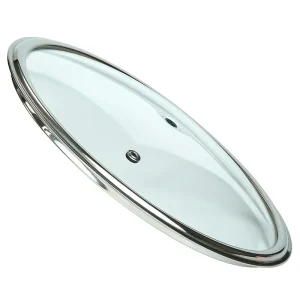
Material Standards and Certifications: Ensuring Trustworthiness
For international buyers, compliance with safety standards is non-negotiable. Glass lids come into direct contact with food and are exposed to high heat, making regulatory adherence a primary concern. Trustworthiness in manufacturing is demonstrated through recognized certifications.
Key Certifications for Glass Cookware
- LFGB (Germany): The German Food and Feed Code. It tests for the migration of harmful substances from materials into food. Passing LFGB is a stringent requirement for exporting to the European Union, particularly Germany.
- TUV Certification: A mark of safety and quality. TUV tests assess thermal shock resistance, mechanical strength, and durability. It assures retailers and consumers that the product meets rigorous European safety norms.
- ISO9001: This certification validates the manufacturer’s quality management system. It ensures consistent processes, traceability, and continuous improvement in production practices.
EUR-ASIA COOKWARE CO.,LTD. holds ISO9001 certification, and our products have successfully passed LFGB and TUV certifications. These credentials are not just badges; they represent our commitment to producing safe, reliable kitchenware. Our annual output of over 15 million pieces maintains this standard, proving that scale does not compromise quality. For buyers targeting markets in France, Spain, Switzerland, and beyond, these certifications facilitate smoother customs clearance and retail acceptance.
Common Defects in Glass Lid Manufacturing and How to Avoid Them
Understanding potential defects helps buyers evaluate supplier quality controls. Here are common issues and how professional manufacturers mitigate them:
1. Thermal Shock Breakage
Cause: Inconsistent tempering or rapid temperature changes during use.
Solution: Precise control of the tempering furnace’s cooling zones. Manufacturers should conduct random thermal shock tests, such as plunging hot lids into ice water, to verify batch integrity.
2. Optical Distortions
Cause: Uneven mold temperature or impurities in the raw glass.
Solution: Regular mold maintenance and high-purity raw material sourcing. Automated optical inspection systems can detect distortions invisible to the naked eye.
3. Handle Looseness
Cause: Poor adhesive bonding or mismatched thermal expansion coefficients between glass and handle material.
Solution: Using high-temperature resistant silicones and mechanical locking mechanisms. Rigorous torque testing ensures handles remain secure under stress.
4. Edge Chipping
Cause: Rough handling during grinding or packaging.
Solution: Automated edge grinding with diamond wheels and protective packaging designs. EUR-ASIA employs specialized packaging protocols to protect edges during transit to distant markets like Brazil and South Korea.
Choosing the Right Manufacturing Partner
Selecting a glass lid manufacturer involves more than comparing unit prices. It requires evaluating technical capability, capacity, and reliability. Here are critical factors to consider:
Production Capacity and Scalability
Can the supplier meet your volume demands without lead time delays? With a production base covering 20,000㎡ and an annual output exceeding 15 million pieces, EUR-ASIA COOKWARE CO.,LTD. demonstrates significant scalability. This capacity allows us to handle large orders for major retailers while maintaining flexibility for smaller, customized batches.
Technical Expertise in Special Shapes
Not all factories can produce complex geometries. If your product line includes high-curvature or special-shaped lids, verify the supplier’s mold-making capabilities. Our ability to produce tall, flat, and irregularly shaped covers according to customer demand sets us apart from competitors limited to standard designs.
Export Experience and Market Knowledge
Over 90% of our products are exported to diverse regions including Russia, Poland, Denmark, Turkey, and Japan. This extensive export experience means we understand varying regional preferences and packaging requirements. We navigate logistics and documentation efficiently, ensuring timely delivery regardless of destination.
Frequently Asked Questions (FAQ)
What is the difference between tempered and non-tempered glass lids?
Tempered glass is heat-treated to increase strength and safety. It withstands higher thermal shocks and breaks into harmless granules. Non-tempered (annealed) glass is weaker, prone to breaking into sharp shards, and unsuitable for high-heat cookware applications.
Can glass lids be used on induction cooktops?
Yes, glass lids themselves are compatible with induction cooktops since they do not interfere with the magnetic field. However, the handle material and the pot body must be induction-compatible. The glass lid simply covers the pot, regardless of the heating source.
How long does custom mold development take?
Typically, custom mold design and fabrication take 15 to 30 days, depending on complexity. Once the mold is approved, sample production follows. EUR-ASIA streamlines this process with an in-house mold workshop, reducing lead times for new product launches.
Is screen-printed logo safe for food contact?
Yes, provided the manufacturer uses food-grade, high-temperature ceramic inks and fires them correctly. Our LFGB-certified processes ensure that all printed surfaces are safe and do not leach harmful substances into food.
What is the minimum order quantity (MOQ) for custom designs?
MOQ varies based on design complexity and mold costs. Generally, manufacturers require a minimum run to amortize mold expenses. At EUR-ASIA, we discuss flexible MOQ options to support both emerging brands and established enterprises.
Conclusion: Partnering for Quality and Innovation
Glass lid manufacturing is a blend of art and science. From the precise chemistry of raw materials to the rigorous physics of thermal tempering, every step defines the product’s quality. For businesses seeking to elevate their kitchenware offerings, partnering with a manufacturer that prioritizes customization, compliance, and capacity is essential.
EUR-ASIA COOKWARE CO.,LTD. stands ready to support your growth. Located in China’s National High-tech Development Zone in Taian City, we combine state-of-the-art technology with decades of industry experience. Our ISO9001, LFGB, and TUV certifications guarantee products that meet the highest international standards. Whether you need standard flat lids or complex, high-curvature designs, our team delivers solutions that enhance your brand’s value.
If you are looking for a reliable partner to bring your custom glass lid designs to life, we invite you to connect with us. Let us discuss how our production capabilities can align with your specific market needs.
Explore our full range of glass cookware solutions and request a custom quote today.







