- English
- Chinese
- French
- German
- Portuguese
- Spanish
- Russian
- Japanese
- Korean
- Arabic
- Irish
- Greek
- Turkish
- Italian
- Danish
- Romanian
- Indonesian
- Czech
- Afrikaans
- Swedish
- Polish
- Basque
- Catalan
- Esperanto
- Hindi
- Lao
- Albanian
- Amharic
- Armenian
- Azerbaijani
- Belarusian
- Bengali
- Bosnian
- Bulgarian
- Cebuano
- Chichewa
- Corsican
- Croatian
- Dutch
- Estonian
- Filipino
- Finnish
- Frisian
- Galician
- Georgian
- Gujarati
- Hausa
- Hawaiian
- Hebrew
- Hmong
- Hungarian
- Icelandic
- Igbo
- Javanese
- Kannada
- Kazakh
- Khmer
- Kurdish
- Kyrgyz
- Latin
- Latvian
- Lithuanian
- Luxembou..
- Macedonian
- Malagasy
- Malay
- Malayalam
- Maltese
- Maori
- Marathi
- Mongolian
- Burmese
- Nepali
- Norwegian
- Pashto
- Persian
- Punjabi
- Serbian
- Sesotho
- Sinhala
- Slovak
- Slovenian
- Somali
- Samoan
- Scots Gaelic
- Shona
- Sindhi
- Sundanese
- Swahili
- Tajik
- Tamil
- Telugu
- Thai
- Ukrainian
- Urdu
- Uzbek
- Vietnamese
- Welsh
- Xhosa
- Yiddish
- Yoruba
- Zulu
- Kinyarwanda
- Tatar
- Oriya
- Turkmen
- Uyghur


Glass Lid Export & Bulk Shipping Guide: Packaging, Damage Control and Logistics Tips
2026-10-22
Abstract: Professional guide for bulk importers on glass lid packaging, damage prevention, sea/air shipping and customs clearance tips when sourcing from China.
Why Proper Packaging Is Critical for Bulk Glass Lid Shipments
Glass lids are among the highest break-risk items in kitchenware shipments.
Even standard tempered glass can crack, chip or shatter under repeated vibration, stack pressure and temperature changes during long sea or air transit.
A single broken lid in a carton can easily scratch or damage every other unit packed nearby, turning a small quality issue into a costly order loss.
For importers, poor packaging does not only lead to product waste.
It also creates extra costs for replacement orders, emergency re-shipping and customer complaints that damage long-term retail and distribution relationships.
This is why reliable glass lid export packaging is never treated as an afterthought by experienced suppliers, but designed as part of the entire sourcing and delivery plan.
Standard Export Packaging Solutions for Different Glass Lid Types
There is no single perfect packaging design for all glass lid orders.
The right solution depends on lid size, material, order volume and whether the units will be re-sold directly to end customers or repackaged locally.
Individual foam wrap + inner box packaging for single glass lid
For small to medium batches and retail-ready orders, the most widely used base layer is individual protective wrapping.
Each glass lid is first separated by a layer of protective foam or bubble film, which prevents direct surface friction and absorbs minor impact during handling.
For lids with silicone rims, stainless steel knobs or metal accessories, extra edge protection is strongly recommended.
Hard components such as knobs can easily press through thin bubble wrap and leave pressure marks on adjacent glass surfaces if not properly isolated.
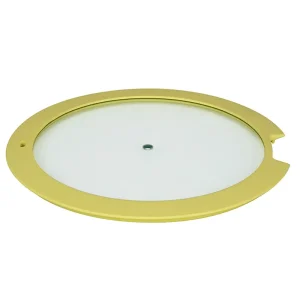
After individual wrapping, each unit is placed into a dedicated inner box that provides enough rigid support to avoid side deformation.
Outer carton and palletizing standards for full container loads
When the order volume reaches a full 20ft or 40ft container, outer carton quality and palletizing become the most important factors for damage control.
Export-grade double wall corrugated cartons are the industry standard, with stacking strength calculated to withstand at least four layers of similar cartons placed on top without permanent deformation.
Standard export pallets are usually made of solid wood or high-quality plywood, and must comply with the ISPM 15 fumigation requirements for international shipping.
All cartons should be aligned evenly on the pallet, with no overhanging edges that can be hit by forklifts or other cargo during loading.
Adding plastic corner protectors around each pallet further reduces the risk of impact damage at the edges.
Custom packaging options for branded retail orders
For importers who sell glass lids under their own brand, packaging often needs to balance protection and shelf appeal.
Common custom options include colour printed retail boxes, blister inserts that hold each lid securely in position, and custom outer shipping marks that show brand information, order number and handling warnings.
It is important to note that more decorative packaging does not always equal better protection.
Many branded retail boxes are thinner than standard export cartons, so suppliers usually add an extra layer of master outer carton outside the retail packaging for international transit.
This way the retail presentation remains clean and undamaged when the goods arrive at the destination warehouse.
Proven Methods to Reduce Glass Lid Breakage Rate During Transit
Even with standard packaging, many importers still face unexpected breakage in real shipments.
Most of these issues can be avoided by following several proven control measures that leading glass lid exporters apply routinely.
- Select the correct foam thickness according to lid weight. Thicker and heavier tempered glass lids require at least 3mm or more of high density foam padding around the edges.
- Leave empty buffer space inside each carton. Do not overfill cartons to the point where the sides bulge under pressure. A small amount of flexible filler can absorb vibration instead of transferring it directly to the glass.
- Add clear “Fragile” and “Do Not Stack” shipping marks on all outer cartons and pallets. This helps warehouse and port teams arrange the cargo in more suitable positions inside the container.
- Perform a drop test before mass packing. A simple test from 80cm height onto a hard floor can quickly show whether the current packaging design can withstand normal logistics handling.
At the same time, there are three common packaging mistakes that many new importers overlook: using thin ordinary cartons instead of export-grade corrugated ones, placing glass lid pallets at the bottom of the container under other heavy cargo, and skipping foam edge protection to cut small packaging costs.
All these mistakes can lead to a sharp rise in final breakage rate.
For well-managed full container load glass lid export shipments that follow all these protection rules, the industry standard target breakage rate can be controlled below 0.5%.
This is much lower than the 2% to 5% breakage rate that many new importers experience when using general kitchenware packaging without specific glass protection design.
Sea Freight vs Air Freight: Choose the Right Shipping Mode for Your Glass Lid Order
Choosing between sea freight and air freight for glass lid shipments is not only about price.
It also affects transit time, breakage risk and overall inventory planning for your distribution business.
Cost and transit time comparison for different order volumes
For large volume orders above 5000 units, sea freight is almost always the most cost-effective choice.
Although the transit time from major Chinese ports to most European and North American destinations usually ranges from 18 to 35 days, the unit transportation cost is significantly lower than air freight, making it ideal for regular stock replenishment.
For small trial orders, urgent restocks or seasonal inventory requirements, air freight can be a better option.
The shorter total transit time reduces the number of handling transfers and vibration cycles the glass lids experience, which sometimes results in even lower final breakage rates than long sea voyages.
Key considerations for LCL and FCL glass lid shipments
Less than container load (LCL) shipping is common for medium batches, but it also brings extra risk.
In shared containers, glass lid cartons may be placed next to heavy metal parts, sharp tools or other cargo that can shift and cause impact during the voyage.
If you choose LCL, it is strongly recommended to reinforce your pallets with stretch film and clearly mark the cargo as fragile.
Full container load (FCL) shipments give you full control over how the glass lids are arranged and fixed inside the container.
There is no risk of other shippers’ goods damaging your stock, which makes FCL the preferred option for large regular glass lid distribution orders.
Customs Clearance Tips for Importing Glass Lids to Different Markets
Customs clearance is the final critical step in glass lid export, and missing required documents can lead to unexpected delays, extra storage fees or even cargo hold at the port of destination.
Unlike general non-fragile kitchenware, glass lid shipments are sometimes marked as high-risk fragile goods by customs authorities in certain regions, which may trigger extra manual inspection.
For most major markets, tempered glass lids for cookware fall under general kitchenware tariff codes.
However, importers need to pay extra attention to food contact safety documentation.
Markets such as the European Union, the United States and many other developed regions require suppliers to provide valid test reports that prove the glass, silicone rim and any metal components comply with local food contact material regulations.
Before shipment, confirm with your supplier that all product descriptions, packaging marks and invoice information are consistent.
Inconsistent product names or unclear material declarations are among the most common reasons for customs inspection delays in glass lid shipments.
If you are looking for more guidance on selecting qualified suppliers that follow these strict packaging and export standards, you can refer to our complete supplier selection guide for glass lid sourcing.

What is the standard breakage rate for bulk glass lid shipments?
With proper export-grade packaging and professional loading, most reliable suppliers can maintain a breakage rate below 0.5% for full container orders.
This figure applies to well-planned FCL shipments with reinforced packaging, and does not represent the expected breakage rate for unstandardized small LCL batches.
Can glass lids be shipped together with other non-fragile kitchenware?
Yes, but it is recommended to place glass lid pallets on the top layer of the container and separate them from heavy or sharp goods to avoid accidental impact.
What documents are usually required for glass lid customs clearance?
Common base documents include commercial invoice, packing list and bill of lading.
For the US market, FDA food contact test reports are usually requested; for EU markets, LFGB or similar EU food contact compliance documents are often required.