- Chinese
- French
- German
- Portuguese
- Spanish
- Russian
- Japanese
- Korean
- Arabic
- Irish
- Greek
- Turkish
- Italian
- Danish
- Romanian
- Indonesian
- Czech
- Afrikaans
- Swedish
- Polish
- Basque
- Catalan
- Esperanto
- Hindi
- Lao
- Albanian
- Amharic
- Armenian
- Azerbaijani
- Belarusian
- Bengali
- Bosnian
- Bulgarian
- Cebuano
- Chichewa
- Corsican
- Croatian
- Dutch
- Estonian
- Filipino
- Finnish
- Frisian
- Galician
- Georgian
- Gujarati
- Haitian
- Hausa
- Hawaiian
- Hebrew
- Hmong
- Hungarian
- Icelandic
- Igbo
- Javanese
- Kannada
- Kazakh
- Khmer
- Kurdish
- Kyrgyz
- Latin
- Latvian
- Lithuanian
- Luxembou..
- Macedonian
- Malagasy
- Malay
- Malayalam
- Maltese
- Maori
- Marathi
- Mongolian
- Burmese
- Nepali
- Norwegian
- Pashto
- Persian
- Punjabi
- Serbian
- Sesotho
- Sinhala
- Slovak
- Slovenian
- Somali
- Samoan
- Scots Gaelic
- Shona
- Sindhi
- Sundanese
- Swahili
- Tajik
- Tamil
- Telugu
- Thai
- Ukrainian
- Urdu
- Uzbek
- Vietnamese
- Welsh
- Xhosa
- Yiddish
- Yoruba
- Zulu
- Kinyarwanda
- Tatar
- Oriya
- Turkmen
- Uyghur

Tempered Glass Lid with Silicone Rim: Sealing and Heat Performance
2026-11-13
Two lids can leave the same factory with the same diameter, the same glass thickness and the same silicone rim color, and behave like different products in the kitchen. One seats quietly on the pot, holds its seal through a simmer and still looks new after a year of daily washing. The other lets steam out around half the circumference, collects water under the rim, and shows a gasket that has gone stiff and slightly brown at the contact line within months.
The difference is rarely visible in a product photo, and it is rarely the glass alone. A tempered glass lid with silicone rim is a two-material assembly in which each part changes how the other performs: the glass sets the mechanical and thermal limits, the gasket sets the sealing behavior, and the joint between them decides how long both keep working.
This guide looks at that interaction from a buyer’s and product engineer’s point of view, and it is organized around the three questions that decide a program: what the rim actually does on a cookware glass lid, what it can and cannot withstand, and how sealing fails in practice. It closes with the specification and inspection items that keep those failures out of a shipment. Where a figure belongs on your drawing — compression, tolerance, test differential — it stays there rather than being borrowed from a web page.
What the Silicone Rim Actually Does on a Tempered Glass Lid
Anatomy: glass disc, gasket cross-section, handle interface
A lid of this type has three structural zones, and each is a potential source of complaints.
- The glass disc. Flat or domed, with a ground or polished edge. Its diameter, thickness, flatness and edge condition are fixed once tempering is done.
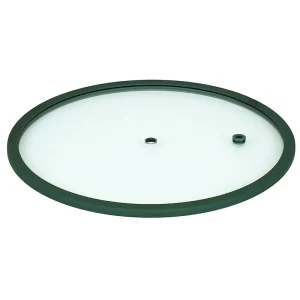
- The silicone rim. The cross-section is what matters, and three families are common: a wrap-around profile that folds over the glass edge on both faces, an inlay or channel profile where the glass sits inside a U-shaped groove, and a lip profile that bears against the pot rim while gripping the glass over a narrower band. The quick way to tell them apart: look at whether the glass is seated inside a channel or clamped between two faces.
- The handle interface. The knob or handle is either mounted through the glass or carried by a metal spider or the rim assembly. Which one it is determines whether the glass or the joint carries the lifting load.
A single product photo cannot tell you which cross-section you are buying. Two suppliers can show the same silhouette and ship a wrap-around gasket and a channel gasket respectively, with different compression behavior, different edge coverage and different replacement logic. Ask for a section drawing, not an image.
Three jobs: sealing, edge protection, seating
The rim on a glass lid is usually described as a seal. In practice it performs three functions that can fail independently.
- Sealing. The gasket closes the gap between the pot rim and the glass, restricting the escape path for steam and limiting condensate that runs down the outside of the pot.
- Edge protection. Tempered glass carries high internal stress, and its cut edge is the most sensitive region of the part. The gasket covers that edge and absorbs impact from stacking, dish racks, transport and daily handling.
- Seating and location. The lower profile of the rim provides the resting surface and the lateral location that stop the lid sliding when the pot is tilted or when steam pressure builds under it.
Each function can be checked on a sample without instruments: press and twist the rim at several points around the circumference (sealing grip and clamping), look along the glass edge for gaps or exposed glass (edge protection), then seat the lid on the actual pot, tilt it and lift it by the handle (seating). A lid that passes one check can fail another, which is why “it looks fine on the table” settles very little.
Why tempered glass changes the gasket requirement
Tempering imposes a constraint that shapes every rim decision: tempered glass cannot be cut, drilled or re-shaped afterwards. The glass disc is finished before the gasket exists, so the gasket has to adapt to the glass — its diameter, its flatness or dome, its edge profile — and never the other way around.
Three consequences follow for buyers:
- Edge coverage becomes a specification item. If the gasket band is narrow, more of the stress-bearing edge stays exposed. On a decorative lid that is stacked carefully this may be acceptable; on a lid that gets lifted while loaded, or washed in racks, it is not.
- Flatness variation turns into uneven compression. A glass disc that is not flat, or a dome that is not symmetric, produces a gasket that is compressed more in some sectors than others. The lid still looks correct, and the leak appears only on the pot.
- “Can you make it fit my other pot?” is the wrong question. The glass cannot be resized. Only the gasket geometry, the pot interface, the tooling — or the lid — can change. Settling this early avoids an expensive assumption late in a project.
Silicone Material and Temperature Range
Material types used for lid gaskets
Two process families dominate, and the choice is commercial as much as technical.
- Solid silicone rubber (HCR), compression molded. Lower tooling cost, well suited to multi-color and mid-volume programs, with good tolerance to pigment changes. Dimensional consistency depends on mold quality and cure control.
- Liquid silicone rubber (LSR), injection molded. Higher tooling cost, better suited to high-volume runs and to thin, precise sections, with tighter dimensional repeatability and good transparency.
Hardness, usually expressed in Shore A, is the parameter that governs how the rim feels and how it seals: a softer compound conforms more readily to an uneven pot rim and compresses at lower force, but deflects more under the lid’s own weight and can roll or extrude at the contact line. A harder compound holds its shape and resists compression set better, but transmits more of the pot’s irregularities instead of absorbing them. Hardness also interacts with the groove width in the rim profile — the two are designed together, not selected separately.
Ask for the compound family, the hardness range and the cure system in writing, and confirm whether the quoted hardness applies to the finished part or to the raw compound. Suppliers often describe the material as food grade silicone; that phrase is a label rather than a specification, and the documents behind it are what belong in your file.
Temperature range: continuous, short-term, and cold
This is the section where most supplier pages quote a number and most buyers file it without checking. A single figure such as “up to 230 °C” tells you almost nothing useful, because the usable range of a silicone gasket is a property of the specific compound and the specific application, not of the material category.
Four parameters have to be confirmed for the compound you are actually buying:
- Continuous service temperature — the ceiling for repeated, sustained exposure, not a one-off peak.
- Short-term or peak temperature — how hot, for how long, and how many times. A peak rating is meaningless without a duration and a count.
- Low-temperature behavior — below a certain point the elastomer loses rebound and the seal stops recovering after compression. A lid stored in a cold warehouse and then used on a hot pot experiences both ends of the range.
- Aging behavior within that range — hardness drift, compression set, loss of rebound, and volatile loss over time. A gasket that stays elastic but creeps permanently flat has failed even if it never discolored.
The practical consequence is deliberate: no temperature figure is quoted here as a product claim. The number that belongs in your specification is the one printed on the compound supplier’s technical data sheet and confirmed by a test report for the finished part. Two rims that look identical can carry genuinely different ratings, and a catalogue figure is a claim to verify, not a property to design against.
A second point follows from the same logic. Temperature resistance is usually discussed as a material question, but on a lid it is an assembly question: the gasket sits against a glass edge that reaches temperature quickly and a pot rim that may be much hotter than the rest of the lid. The relevant question is not only “what can the silicone take” but “what temperature does the gasket actually see at the contact line, and for how long”. For a lid used on a low simmer, the two answers are very different from a lid used on a high-output burner with frequent deglazing.
Food-contact compliance and what the certificate must say
Compliance is a documentation exercise before it is a materials exercise. Three frameworks matter most in export programs, and they are not interchangeable.
| Market | Framework | What the supplier should be able to show |
|---|---|---|
| United States | FDA 21 CFR 177.2600 — rubber articles intended for repeated use | Formulation compliance statement, plus extraction test data for the finished article where applicable |
| European Union | Regulation (EC) 1935/2004 framework and GMP Regulation (EC) 2023/2006; no harmonized specific EU measure for silicone rubbers, so national rules apply — in Germany, BfR Recommendation XV “Silicones” under LFGB §30/§31 | Declaration of compliance referencing the applicable national measure, with migration test data under the conditions the report names |
| China | GB 4806.11 — food-contact rubber materials and articles | Test report from an accredited laboratory, with the grade and color identified |
Two differences are worth knowing before you compare quotations. First, LFGB practice places strong weight on organoleptic performance — the article must not impair the taste or smell of food — which makes a sensory evaluation part of the test battery rather than an afterthought. Second, silicone sits in an unusual position in the EU: because there is no harmonized specific measure at Union level, a supplier’s “EU compliant” statement means little on its own. Ask which national measure the declaration references.
Then check the report against the order. Four questions catch most of the gaps:
- Does it name the color being shipped? Pigments change the formulation.
- Does it name the hardness? A different compound means a different report.
- Does it state the simulant, temperature and duration used, and do those conditions match how the lid is actually used — aqueous, acidic, fatty, hot?
- Is there a traceable link between the report and the batch you are buying, or only to a generic “silicone” category?
A supplier who cannot answer all four is offering a material, not a compliant part. It is also worth remembering that a report issued for one market is not automatically reusable in another: the framework, the test conditions and the declaration wording all differ, so plan the documentation per destination rather than assuming one file covers every customer. And note the limit of this section — nothing here is a compliance conclusion for a specific SKU. Suitability depends on the compound, the process, the color and your target market, and it has to come from documents tied to the goods you receive.
Sealing Performance and Pot Compatibility
How the seal works, and where the steam goes
Silicone seals by elasticity. The gasket is compressed between the glass and the pot rim, and it recovers after compression; the seal is maintained by that recovery force plus the width of the contact band. Three factors set how well it works: the compression designed into the rim profile, the hardness of the compound, and the consistency of the surfaces on both sides.
Two practical points follow, and both are commonly misunderstood in procurement.
A silicone rimmed lid is not airtight, and usually should not be. If the lid sealed completely on a heated pot, pressure would build inside, and on cooling the lid would be drawn down onto the pot. Opening then becomes a small steam event rather than a routine action. This is why many cookware lids deliberately keep a relief path: a glass lid with a vent hole, a gap in the gasket profile, or a controlled clearance at the seating surface. The design intent is to limit steam loss and condensate, not to achieve vacuum.
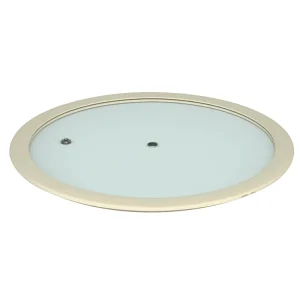
The relief path is part of the seal specification. A vent hole changes how much steam escapes and where condensate forms. A gasket with a molded notch vents in one direction only, which matters if the user rotates the lid. If you buy a lid with a vent, specify its position and confirm it is present in the tooling rather than added by drilling — it cannot be drilled after tempering.
Pot compatibility: diameter, rim profile, and shape
Fit problems on a gasketed lid concentrate at the pot interface, not at the glass. Four variables decide whether a lid that measures correctly will actually seal.
- Which diameter the lid seats on. A gasket that bears on the pot’s outer edge behaves differently from one that sits inside the opening. Outer-seating designs are more forgiving of rim variation and easier to lift; inner-seating designs locate more firmly but are sensitive to the pot’s inner diameter and roundness.
- Rim profile. A flat rim, a rolled or flanged rim and a thick cast-iron rim present very different contact surfaces. A gasket designed for a flat rim will bridge a rolled edge on a narrow band, which concentrates compression and accelerates aging at that line.
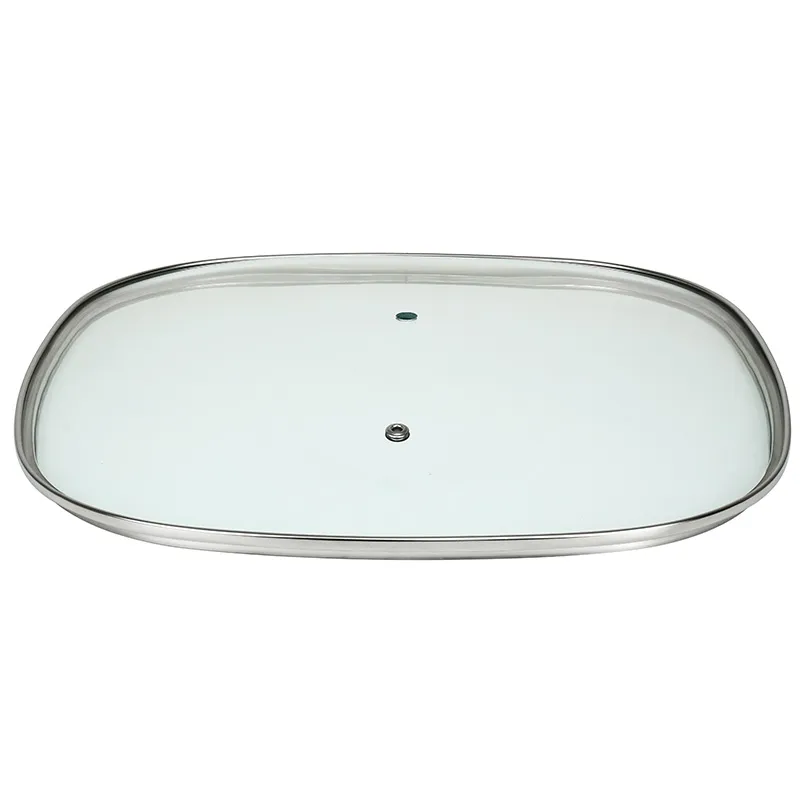
- Pot shape. A round glass lid is governed by one diameter plus roundness deviation. A square glass lid is governed by two axis dimensions plus corner radius, and the diagonal decides whether the lid clears the opening at all. Corners are also where gasket compression is hardest to keep uniform.
- Glass profile. A domed lid and a flat lid sit at different heights relative to the pot, and the rim has to follow. A gasket designed for a flat disc, pressed onto a dome, shows uneven contact that is invisible on the sample table.
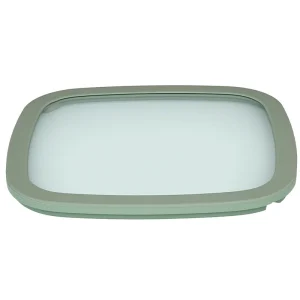
The table below describes structural tendencies for selection purposes. It is not validated performance for any specific SKU, and it should be checked against the pot and the cooking regime in front of you.
| Pot / lid situation | Gasket behavior to expect | What to verify on a sample |
|---|---|---|
| Flat pot rim, flat glass lid | Even contact band, most predictable sealing | Contact band width around the full circumference |
| Rolled or flanged rim | Contact concentrates on a narrow line; higher local compression | Whether the gasket bridges or conforms; compression set at that line |
| Cast iron or thick rim, rough surface | Soft compound conforms better; hard compound may leak at high spots | Seal at several points on the actual pot, not on a gauge |
| Square or rectangular vessel | Corner compression uneven; corners age first | All four corners, plus diagonal clearance |
| Wide pot, heavy lid | Higher unit load on the gasket; more creep risk | Compression set after a period under load |
| Small pot, light lid | Gasket may not be compressed enough to seal | Minimum compression achieved under the lid’s own weight |
Variables that decide whether it seals in practice
When a lid passes dimensional inspection and still leaks, the cause is usually one of six things. Each has a different corrective action, which is why “it leaks” is not a useful complaint to send a supplier.
| Variable | Typical symptom | Where the fix sits |
|---|---|---|
| Gasket hardness too high for the pot rim | Leak at low compression; condensate escaping at one sector | Compound selection |
| Insufficient compression designed into the profile | Steam escapes around most of the circumference | Rim profile / drawing |
| Groove width mismatched to gasket thickness | Gasket rolls, extrudes or sits loose in the channel | Tooling |
| Glass flatness or dome deviation | Leak in one sector only; gasket visibly more compressed opposite | Glass specification |
| Pot roundness deviation or rough rim | Intermittent leak that moves as the lid is rotated | Cookware-side control |
| Handle offset or heavy knob | Lid tilts, lifting the gasket on one side | Handle position and mass balance |
Compression ratio, groove width and clearance are drawing and contract parameters. They depend on your pot’s roundness, the gasket hardness, the lid’s weight and your product line, and they should be agreed in writing and measured at inspection rather than adopted from a template.
Heat Performance: Thermal Shock, Edge Stress, and What the Gasket Can and Cannot Do
What tempering buys you, and where it is fragile
Tempering puts the glass surface into compression and the interior into tension. That is what gives a lid its resistance to mechanical impact and to rapid temperature change, and it is why a tempered lid that does fail usually breaks into small, comparatively blunt fragments rather than long shards.
The trade-off is that the benefit is concentrated at the surfaces and the vulnerability is concentrated at the edges. Cut and ground edges, any chip, and any point where the gasket leaves glass exposed are where failures typically begin. A gasket that covers the edge continuously protects that zone; a gasket that grips at intervals leaves the sections between the grip points exposed, which is workable for light decorative lids and questionable for lids that are lifted under load or stacked in racks.
This also explains why the rim is a functional part rather than trim. On a tempered lid, the edge cannot be repaired or re-finished after tempering, so the protection has to be designed in from the start.
Thermal shock behavior and applicable test references
Thermal shock testing asks a simple question with a specific method: how large a temperature differential, applied how many times, before the glass cracks or the rim assembly loosens. A supplier describing a product as a thermal shock resistant glass lid is making a claim that should be backed by a report stating the differential, the cycle count and the sample configuration — not by an adjective on a product page.
Three reference points are worth knowing, and they serve different purposes:
- EN 12150 (thermally toughened soda-lime silicate safety glass) provides test methods and fragmentation criteria for tempered glass. Its fragmentation test is a useful way to verify that the glass was actually tempered, not merely heat-strengthened.
- GB 15763.2 (safety glass — tempered glass) provides the comparable Chinese framework, including fragmentation requirements.
- EN 12983-1:2023 (domestic cookware for use on top of a stove) is the cookware-specific reference. The 2023 edition added requirements for thermally toughened glass lids, and its lid-design clause sets a removal-force criterion: the lid shall be removable using a force no greater than its own weight plus 2 N, in any position, tested at 23 ± 5 °C both before and after a quantity of water equal to the usable capacity is brought to the boil and allowed to cool.
The distinction matters. EN 12150 and GB 15763.2 tell you whether the glass is properly tempered; EN 12983-1 tells you whether the lid behaves as cookware. A supplier report that cites only a glass standard has not tested the assembly, and a report that cites a large differential without stating the number of cycles, the sample size and the lid configuration has not told you much either.
What should appear in the report: the differential applied, the number of cycles, the sample dimensions and thickness, the rim configuration tested, and the pass criterion (no breakage, no rim loosening, no gasket displacement). Without those, “passed thermal shock” is a phrase rather than a result you can compare across suppliers.
The gasket’s contribution — thermal buffering and its limits
There is a persistent assumption that a silicone rim “protects the glass from heat”. It is worth being precise about what the gasket actually does.
What it can do:
- Reduce direct conduction between the pot rim and the glass edge, because the contact passes through a low-conductivity elastomer rather than metal-to-glass contact.
- Slow the rate of local temperature change at the covered edge, which is the region most sensitive to differential stress.
- Absorb minor mechanical loads at the edge during seating, tilting and lifting, which is a mechanical benefit that happens to matter in hot use.
What it cannot do:
- It cannot change the stress state of the glass. A poorly tempered disc, or one with a damaged edge, remains a poorly tempered disc under a gasket.
- It cannot compensate for an exposed edge. Protection only exists where the gasket covers.
- It cannot survive indefinitely at the contact line. Aging reduces rebound, and a gasket that has lost rebound stops sealing before the glass becomes a problem — which is the normal end of life for this design.
That last point deserves a working judgment rule, because “the rim looks fine” is a poor test. A gasket has reached the end of its service life when rebound is visibly reduced on release, a permanent depression remains along the contact line, or the surface has hardened enough that it no longer conforms to the pot rim. Discoloration alone is cosmetic; loss of recovery is not.
So the gasket is a contributor to thermal performance, not a substitute for glass quality. Buyers who treat a silicone rim as permission to relax the glass specification usually discover the error at the worst moment: after the tooling is paid for.
Color and Appearance Customization
Color programs and batch-to-batch consistency
Color is the most visible customization and the one most likely to generate a claim, because “the same color” is an agreement, not a fact.
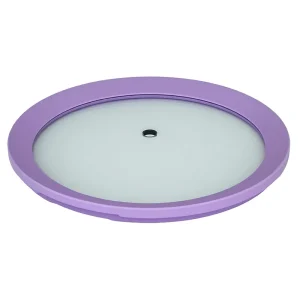
- Reference system. Colors are normally matched to a Pantone reference or to a physical master chip. A Pantone number narrows the range; it does not fix it, because silicone renders color differently from print.
- Translucency. Transparent, translucent and opaque compounds of the same nominal color read differently against a glass lid and against a pot. Confirm which the reference was set on.
- Measurement conditions. Color difference should be judged under an agreed light source, at an agreed wall thickness, with an agreed instrument and tolerance. Without those three, a rejection is an opinion.
- Cost drivers. Changing color means cleaning the molding equipment and, at low volumes, a minimum batch per color. Multi-color parts add a second operation and a joint that has to be evaluated for food contact.
In a customized glass cover program, the gasket is usually the last item fixed and the first item that constrains the schedule, because the glass dimensions and the pot interface are settled earlier. Starting the color and profile work in parallel with the glass drawing, rather than after it, is the difference between one tooling round and three.
Appearance options and their performance trade-offs
Most appearance choices on a gasket are harmless. A few are not, and they tend to be the ones that look best in a rendering.
| Option | What it changes | What to check |
|---|---|---|
| Matte vs glossy finish | Demolding texture, feel, residue visibility | Cleanability at the contact line; whether the matte surface harbors residue |
| Two-color or dual-durometer molding | Appearance plus harder and softer zones | The joint: integrity, and whether it sits on a food-contact face |
| Printed or laser-marked logo | Branding | Position — never on the contact face; ink or marking compliance for food contact |
| Profile styling (thicker lip, decorative ridge) | Perceived quality | Effect on compression and on gasket roll at the contact line |
| Color matching to the cookware body | Brand consistency | Cross-material match: silicone against painted or coated metal rarely matches exactly |
One design point deserves a firm rule. A logo or decorative element printed on the surface that contacts food is a compliance question, not an aesthetic one. Confirm the ink or marking method has its own food-contact documentation, or move the mark to a non-contact surface.
Silicone Rim vs Stainless Steel Ring: Where Each Wins
This comparison is about fitting the application, not about declaring a winner. Both structures are legitimate and both are sold in volume. The differences that matter are in sealing behavior, heat and cleaning durability, and the service model the brand wants to run.
Sealing and tolerance to pot variation
A silicone rim seals by elasticity: it conforms to the pot rim and absorbs small irregularities, so it tolerates a pot that is slightly out of round, slightly rough, or slightly different from the drawing. A stainless ring seals by geometry: surfaces meet, clearances restrict flow, and stability comes from mass and fit. On a consistent, well-controlled pot rim, both work; on a variable one, the elastomer is more forgiving and the metal ring depends on the pot being right.
Heat, cleaning, and service life
Metal rings tolerate high heat and aggressive cleaning better than elastomers do, and they do not age the way gaskets do. Silicone handles thermal cycling well within its rated range, but it is a wear part: it hardens, takes on odor, loses rebound, and eventually needs replacement. Where a lid is used and washed under commercial conditions — frequent cycles, high heat, dish racks — the metal structure’s tolerance for that treatment is a real advantage. In home use, with gentler cleaning, the practical gap is smaller than marketing usually suggests.
Cost and replacement model
A ring is a structural component; a gasket is a wear part. That difference drives the economics and the after-sales story.
- A ringed lid is effectively a single purchase. Cost sits in material, forming and assembly, and the product is designed not to need service.
- A gasketed lid is usually cheaper to build, but it implies a replacement path. That path only works if the gasket is genuinely user-replaceable, if the replacement part is available in the market, and if removal and refitting are easy enough that a consumer will actually do it.
Brands should decide deliberately which model they are running. A gasketed lid sold into a market with no spare-part channel quietly becomes a disposable lid, and that is a positioning decision, not an engineering one.
Decision table by pot type, heat load, and service model
| Situation | Silicone rim | Stainless steel ring |
|---|---|---|
| Open flame, high heat, frequent use | Workable, but confirm the compound’s rating at the contact line | Preferred — no elastomer to age |
| Low-moisture electric cooking, gentle heat | Often preferred for conforming fit and quieter seating | Workable; geometry-dependent |
| High-frequency commercial washing | Gasket aging accelerates; replacement frequency rises | Preferred for abuse tolerance |
| Pot rims with visible variation or roughness | Preferred — elastic conformance | Depends on the pot being controlled |
| Low-cost high-volume program | Usually lower build cost | Depends on forming and assembly cost |
| Program with a spare-parts channel | Preferred — a serviceable wear part | Not applicable |
| Premium exterior appearance | Limited to gasket color and profile | Wide finish options |
As before, this describes structural tendencies, not validated performance for a specific product. Check it against the actual pot, the cleaning regime and the service model.
Purchasing and Inspection Checklist
RFQ data sheet: what to send
Send parameters, not photographs. A complete RFQ prevents the most common failure mode in this category: a supplier quoting against an interpretation of your image.
| Item | What to state |
|---|---|
| Pot interface | Inner or outer diameter at the seating plane, rim profile (flat / rolled / flanged), rim thickness |
| Glass | Diameter or axes plus corner radius, thickness, flat or domed, edge condition required |
| Gasket | Compound family, hardness range, cross-section type (wrap / channel / lip), color reference |
| Retention | How the gasket is held: molded channel, adhesive, mechanical clamping with the handle |
| Venting | Vent present or not, position and diameter, or the intended relief path |
| Handle | Type, material, and whether mounted through the glass or carried by a metal spider |
| Compliance | Target market, the applicable framework, and the documentation you require |
| Color control | Reference chip or Pantone, light source, instrument, tolerance |
| Documentation | Compound TDS, test reports, declaration of compliance, sample quantity |
| Packaging | Edge protection, carton configuration, drop-test expectation |
| Commercial | Sample lead time, production lead time, MOQ, price basis, spare-part availability |
Thickness is where catalogue shorthand causes trouble. The figure most often quoted for a cookware lid — a 4 mm tempered glass lid in catalogue language — is a starting point, not a specification. Confirm it on the drawing, on the sample and on the delivered batch, along with the tolerance that applies. In a tempered glass lid OEM program, the assembly drawing, not the component drawings, is the controlling document; that is where glass, gasket, retention and handle are fixed together.
Sample validation before volume production
Validate a sample against four things, in this order, because each one can invalidate the next.
- Assembly on the real pot. Seat it empty, with water, tilted, and lifted by the handle. Check that the lid comes off using a force no greater than roughly its own weight plus 2 N — both cold and after a boil-and-cool cycle. A lid that needs a firm pull when cold, or that sticks after cooling, has a venting or compression problem.
- Gasket and glass joint. Look for gaps between gasket and glass, gasket displacement under thumb pressure, exposed edge beyond the design, and lips that roll at the contact line.
- Thermal behavior under an agreed method. Run the differential and cycle count both parties have signed off, and record breakage, rim loosening and gasket displacement separately.
- Materials and documentation. Check that the report’s color, hardness and test conditions match the sample in your hand, and run a sensory check — smell and taste — rather than relying on a certificate alone.
A glass lid sample request should state the pot dimensions at the seating plane, the intended market and the documentation you expect with the sample; otherwise the sample arrives dimensionally correct and commercially incomplete. The recurring error at this stage is approving the glass and the gasket separately. Approve the assembly, on the pot it will ship with.
Mass-production inspection points
| Inspection point | Method | Judgment basis |
|---|---|---|
| Gasket retention | Manual twist and press at four or more points per piece | No movement or rotation beyond the agreed allowance |
| Gasket profile | Visual and finger check along the contact lip | No roll, no extrusion, no molding flash at the contact band |
| Glass edge coverage | Visual inspection of the edge around the full circumference | Exposed edge within the designed limit; no chips |
| Color | Comparison against the master chip under the agreed light source | Within the agreed tolerance |
| Key dimensions | Caliper or gauge at drawing-defined points | Within drawing tolerance |
| Vent | Verification of presence, position and freedom from flash | Meets drawing; open, not blocked by molding flash |
| Smell and appearance | Sensory check on a sample per batch | No odor, no discoloration, no contamination |
| Packaging | Review of edge protection and carton structure | Protects the edge through the agreed drop test |
Sampling plans, acceptance limits and defect classification are commercial terms. Set them in the purchase contract with your supplier, define the defect classes in words both sides interpret the same way, and keep the numbers out of the technical description where they do not belong.
FAQ
Is a silicone rim waterproof enough to seal the pot completely?
No, and complete sealing is normally not the design intent. The gasket restricts the escape path for steam and limits condensate; many lids keep a deliberate relief path — a vent, a notch, or a controlled clearance — so that pressure does not build and the lid does not stick after cooling. What matters is how much steam escapes and where, not whether the seal is absolute.
What temperature can the silicone rim withstand, and how is it verified?
That depends on the compound, not on the material category, and it should never be taken from a generic marketing figure. Ask the compound supplier for the technical data sheet and the finished-part test report, and check four things: continuous service temperature, short-term peak with its duration and permitted number of cycles, low-temperature rebound limit, and aging behavior — hardness drift and compression set over time.
Will the silicone rim stop the tempered glass from cracking?
No. The rim reduces direct conduction at the covered edge and absorbs minor mechanical loads, but it cannot alter the stress state of the glass. A disc with poor tempering or a damaged edge remains vulnerable under any gasket, and protection only exists where the gasket actually covers the edge.
Can the rim be replaced by the end user, or is it fixed to the glass?
Both designs exist. A molded channel or a stretched wrap profile can usually be replaced with a spare; an adhesively bonded or mechanically clamped gasket often cannot without tools. If you plan a spare-part program, confirm that replacement is feasible for a consumer, that the part will be available in the target market, and that refitting does not compromise the seal.
Does the rim color affect food-contact compliance?
It can. Pigments and other additives are part of the formulation, so a report issued for one color does not automatically cover another, and multi-color or dual-material parts introduce a joint that has to be assessed. Require documentation per color, and keep printed or marked elements off the food-contact surface.
How do I confirm the rim fits my pot without shipping the pot?
Send the dimensions the gasket actually responds to: the seating-plane diameter, the rim profile, rim thickness and roundness deviation. Then verify on a sample against a pot from your own production, not against a gauge — a lid can be dimensionally correct and still leak because the pot varies. Where shipping a pot is impractical, ask the supplier to confirm the seating geometry in writing and to test the sample against your stated dimensions and tolerance.
Conclusion: Specify the Interaction, Not the Parts
A tempered glass lid with silicone rim is a small assembly in which two materials do each other favors and create each other’s risks. The glass sets a hard limit that cannot be reworked after tempering, so the gasket’s coverage of the edge is a structural decision rather than a cosmetic one. The gasket provides the seal, but it provides it within a temperature and aging window that belongs to the compound — and it eventually ends its life as a wear part, which is a service-model decision rather than a quality defect.
Three habits prevent most of the problems described here:
- Specify the assembly. Glass, gasket, retention method, vent and handle are one system; approving components separately is how fit and sealing failures reach a container.
- Verify on the real pot. Dimensional inspection cannot reveal conformance to a pot that varies.
- Take numbers from documents, not pages. Temperature, compression, migration results and thermal-shock performance each belong to a data sheet or a report tied to the batch you are buying.
If you are selecting a gasketed lid for a cookware program, the fastest route to a reliable answer is to send your pot interface dimensions, target market, cleaning regime and expected volumes, then evaluate samples against the checks above rather than against photographs.